Volume 1
A glossary, or, Collection of words, phrases, names, and allusions to customs, proverbs, etc., which have been thought to require illustration, in the works of English authors, particularly Shakespeare, and his contemporaries / [Robert Nares].
- Robert Nares
- Date:
- 1882
Licence: Public Domain Mark
Credit: A glossary, or, Collection of words, phrases, names, and allusions to customs, proverbs, etc., which have been thought to require illustration, in the works of English authors, particularly Shakespeare, and his contemporaries / [Robert Nares]. Source: Wellcome Collection.
418/494 (page 404)
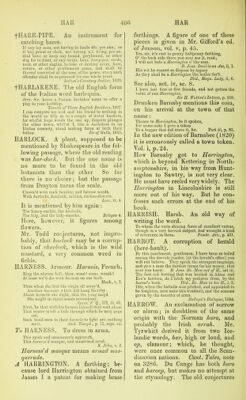
![fHANGERS. Pot-hooks. To liang as tlie pots doe uppon their hangers. Withals’ Dictionarie, ed. 1608, p. 186. f HANGMAN. This word was used as a term of familiarity, and occurs in this sense in Shakespeare. He hath twice or thrice cut Cupid’s bowstring, and the little hangman dare not shoot. M. A. about N., iii, 2. How dost thou, Tom? and how doth NedP’quotb lie; That honest, merry hangman, how doth he ? Hey wood, ls£ part of Ed. IV, v, 3. HANK. A tie, or hold. Therefore the Lord commands, I say, That you his ministers obey ; For if you side for love or money, With crowns that have so oft undone ye, The dev’l will get a hank upon ye. Hudibras Redivivus, part vi, 1706 The other, by making use of some certain personal tilings, which may keep a hank upon such censuring persons, as cannot otherways, a gad, in nature, be ■kindred from being too free with their tongues. The Rehearsal, 1672. Med. Let me alone, I have her on a hank— you must know there was a merchant in the city, that gave me two guineas a time fee, whom I cou’d have kept at least a fortnight longer, and she unknown to me, gave him some sage-posset drink, and the man recover'd in a day and half, but I tlireatn’d her with the college, for pretending to give physick, and brought her upon her knees—hark’e nurse. Ibid. IIANS EN KELDER. A Dutch phrase, signifying literally Jack in the cellar, but jocularly used for an unborn in- fant, and so adopted in English. Coles inserts it in his Latin Dictionary, “Harise in kelder, infans in utero.” The originall sinner in this kind was Dutch; Gallio- belgieus, the Protoplast; and the moderne Mercuries, but lians-tn-keldcrs. The countesse of Zealand was brought to bed of an almanack; as many children as dayes in the yeare. Cleaveland’s Character of a London Liurnall, 1647. Next beg I to present my duty To pregnant sister in prime beauty, Whom [who] well I deem, (ere few months elder) Will take out hans from pretty kelder. Lovelace, p. 63, repr. +The sun wears midnight; day is beetle-brow’d, And lightning is in kelder of a cloud. Cleaveland’s Works. fHANSE. The lintel or upper part of a door-frame. Supercilium, Yitru. quodipsis ostiorum antipagmentis sub ipso superliminari imponitur. 6</>p0s. The home of a doore. Nomenclator, 1585. fHANSEL. Properly, the first money received for the sale of goods, which was considered as fortunate or un- fortunate to the seller, according to circumstances, whence the word was commonly used in a figurative sense. With which wofull tidings being sore astonied, as if it were the first hansell and beginning of evils com- ining toward him. Holland’s Amraianus Marcellinus, 1609. He joyous of these good hansels and overtures to conquest and victorie. Ibid. Being thus after a ridiculous manner lifted up to this degree, in disgrace (as it wrere) and mockerie of all honours, and by way of servile flatterie having made a speech unto the authors of this benefit and advance- ment of his, yea, and promised unto them great riches and dignities for this hansell and first fruits (as it were) of his empire. Ibid. The world is so hard that we find little trade, Although we have all things to please every maid; Come, pretty fair maids, then, and make no delay, But give me your hansel, and pack me away. The Pedlar’s Lamentation, an old ballad. fHAP. Fortune. And to the encreasing of his good haps, he intercepted, &c. Knolles’ Hist, of the Turks, 1610. tTo HAP. To clothe. For whie shoulde he desyre moe? [i. e. garments] seing if he had them, he should not be better hapt or covered from colde, nother in his apparell any whyt the cumlyer. More’s Utopia, 1551. Now whilst old hoary winter mounts the stage. Prepare yourselves i’ th’ combat to engage; Hap weli your backs, and well your bellies fill. Then drink part of a flask, and fear no ill. Poor Robin, 1746. HAPPILY. Corruptly used for haply. If thou art privy to thy country’s fate, Which happily foreknowing may avoid. Haml., i, 1. The following has been given as an example, but is doubtful: Prythee, good Griffith, tell me how he dy’d; If well, lie stepp’d before me happily For my example. Hen. VIII, iv, 2. But this is perfectly clear: But happily that gentleman had business; His face betrays my judgement, if he be Not much in progress. Queen of Array on, O. PL, ix, 440. And this also: Ah, foolish Christians 1 are you, happilie. Those teeth which Cadmus did to earth commit? Fansliaw’s Lusiad, vii, 9. See Johnson, 4, Happily. HAPPY MAN BE HIS DOLE. See Dole. HARBINGER. A forerunner; an offi- cer in the royal household, whose duty was to allot and mark the lodg- ings of all the king’s attendants in a progress. From the word harhorough, or harbergh, a lodging. Harbinger is still a common word in poetry. The practices of the old harbingers are here the subject of allusion : I have no reason nor spare room for any. Love’s harbinger hath chalk’d upon my heart, And with a coal writ on my brain, for Flavia, This house is wholly taken up for Flavia. Albumaz., O. PL, vii, 137. It appears that this custom was still in force in Charles the Second’s reign: On the removal of the court to pass the summer at Winchester, bishop Ken’s house, which he held in the right of his prebend, was marked by the harbinger for the use of Mrs. Eleanor Gwyn; but he refused to grant her admittance, and she was forced to seek for lodgings in another place. Hawkin’s Life of Bp. Ken. HARBOROUGH. Harbour, station shelter. Ilereberga, Saxon. Ah pleasant harhorough of my heart’s thought! Ah sweet delight, the quick’ner of my soul! Tancred and Gism., 0. PL, ii, 220,](https://iiif.wellcomecollection.org/image/b24872180_0001_0418.jp2/full/800%2C/0/default.jpg)