Volume 1
A glossary, or, Collection of words, phrases, names, and allusions to customs, proverbs, etc., which have been thought to require illustration, in the works of English authors, particularly Shakespeare, and his contemporaries / [Robert Nares].
- Robert Nares
- Date:
- 1882
Licence: Public Domain Mark
Credit: A glossary, or, Collection of words, phrases, names, and allusions to customs, proverbs, etc., which have been thought to require illustration, in the works of English authors, particularly Shakespeare, and his contemporaries / [Robert Nares]. Source: Wellcome Collection.
419/494 (page 405)
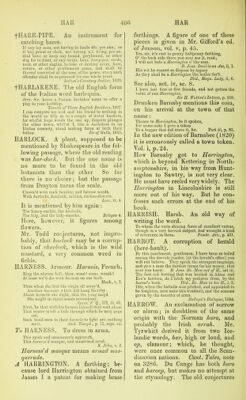
![Leave me those hills where harbrough nis to see, Nor holly bush, nor brere, nor winding ditch. Spens. Shep. Kal., June, 19. Your honourable hulks have put into harborough; they’ll take in fresh water here. Merry Dev., O. PI., v, 258. Also written herborough, which is nearer to the etymology: Like the German lord, when he went out of Newgate into the cart, took order to have his arms set up in liis last herborough (i. e. the cart). B. Jons. Discoveries, vol. vii, 76. fHARBOUR. The place, or covert, where the hart or hind lay. The harbourer was an officer whose busi- ness it was to trace the stray hart to his covert in the forest. fHARD HOLD, with. Stiffly. Bataille ferme. A hot skirmish or battell, wherein both sides stand to it with hard hold. Nomenclator. fHARD HEADS. I found many guests of dyvers factions, some outlaws of England, some of Scotland, some neighbours there- about at cards, some for ale, some for placks and hardhedds. Letter dated Jan. VUh, 1570. HARDIMENT. Courage, or acts of courage. He did confound the best part of an hour In changing hardiment with great Glendower. 1 Hen. IV, i, 3. But, full of fire and greedy hardiment, The youthful knight could not for ought be staid. Spens. F. §., I, i, 14. HARDYHED. Hardihood, hardiness. Spenser. Only an antiquated form of the word. A HARE was esteemed a melancholy animal, probably from her solitary sitting in her form. It was an in- separable consequence of that notion, in the fanciful physics of the time, that its flesh should be supposed to engender melancholy. It was not only in England that the hare had this character. La Fontaine says, in one of his Fables, Dans un profond ennui ce lievre se plongeoit, Get animal est triste, et la crainte lerouge. Liv. ii, Eable 14. Afterwards of the same hare, Le melancolique animal Prince Henry tells Falstaff that he is as melancholy as a hare. 1 Hen. IV, i, 2. Yes, and like your melancholy hare, Deed after midnight. White Devil, 0. PL. vi, 302. The melancholy hare is form’d in brakes and briers. Drayt. Polyolb., Song ii, p. 690. The eyglit tliinge is hare fleslie, which likewise en* gendreth melancholy bloudde, as Basis sayetli in the place afore; alegate this flesh engendreth more melancholy than any other, as Galen saythe. PaynelVs Beg. San. Salerni, p. 22. This was not quite forgotten in Swift’s time. In his Polite Conversation, lady Answerall, being asked to eat hare, replies, “No, madam, they say ’tis melancholy meat.” Dialog. 2. A hare crossing a person’s way was supposed to disorder his senses. When a clown is giving himself very fantastical airs, it is said to him, Why, Pompey, prithee let me speake to him! I’ll lay my life some hare has cross'd him. B. 8p FI. Wit at sev. Weap., ii, p. 276; But the strangest opinion about hares was, that they annually changed their sex, which yet was countenanced by respectable ancient authorities, and not denied by sir Thomas Brown with so much decision as might be expected. Fletcher has alluded to it, which for a poet was allowable: Snakes that cast your coats for new, Camelions that alter hue, Hares that yearly sexes change. Faithf. Shep., iii, 1. Butler has not overlooked it, for a comic allusion: When wives their sexes change like hares. Hudibr., II, ii, v. 705. Brown handles the subject in his Vulgar Errors, III, 17. [The hare was vulgarly supposed to be so fearful that it never closed its eyes, even in sleep. Chapman has drawn from this notion a fine epithet in his Epicodium on the death of prince Henry:] f Relentless Rigor, and Confusion faint, Frantic Distemper, and hare-eyed Unrest, And short-breathed Thirst, with ever-burning breast. [The bone of a hare’s foot was con- sidered to be a remedy against the cramp.] tThe bone of a haires foote closed in a ring, Will drive away the cramp whenas it doth wring. Withals’ Dictionarie, ed. 1608, p. 215. To HARE. The same as to hurry, to harass, or scare. V the name of men or beasts, what do you do? Hare the poor fellow out of his five wits And seven senses. B. Jons. Tale of a Tub, ii, 2. Then did the dogs run, and fight with one another at fair teeth, which should have the lardons; by this means they left me, and I left them also bustling With and hairing one another. OzelVs Rabel., B. ii, ch. 14. HARECOPPE apparently is used for hare-brain ; being composed of hare, and coppe, the top of anything. Other conjectures have been made, but this has most probability. See Cop. A merry harecoppe ’tis, and a pleasant companion, A right CQurtier, and can provide for one. Damon and Pithias, O. PI., i, 222,](https://iiif.wellcomecollection.org/image/b24872180_0001_0419.jp2/full/800%2C/0/default.jpg)