Volume 1
A glossary, or, Collection of words, phrases, names, and allusions to customs, proverbs, etc., which have been thought to require illustration, in the works of English authors, particularly Shakespeare, and his contemporaries / [Robert Nares].
- Robert Nares
- Date:
- 1882
Licence: Public Domain Mark
Credit: A glossary, or, Collection of words, phrases, names, and allusions to customs, proverbs, etc., which have been thought to require illustration, in the works of English authors, particularly Shakespeare, and his contemporaries / [Robert Nares]. Source: Wellcome Collection.
426/494 (page 412)
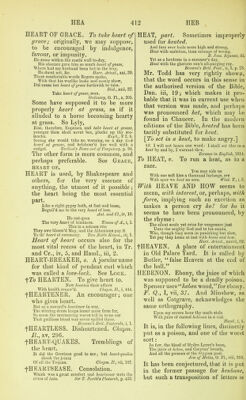
![HEART OF GRACE. To take heart of grace; originally, we may suppose, to be encouraged by indulgence, favour, or impunity. He came within the castle wall to-day, His absence gave him so much heart of grace, Where had my husband been but in the way, He durst not, &c. Harr. Ariost., xxi, 39. These comfortable words Rogero spake. With that his warlike looke and manly show, Did cause her heart of grace forthwith to take. Ibid., xxii, 37. Take heart of grace, man. Ordinary, 0. PI., x, 205. Some have supposed it to be more properly heart at grass, as if it alluded to a horse becoming hearty at grass. So Lyly, Rise, therefore, Euphues, and take heart at grasse, younger thou slxalt never bee, plucke up thy sto- macke. Euph., F 2, b. Seeing she would take no warning, on a day took heart at grasse, and belabour’d her well with a cudgel. Tarlton’s News out of Purgatory, p. 24. The other form is more common, and perhaps preferable. See Grace, heart or. HEART is used, by Shakespeare and others, for the very essence of anything, the utmost of it possible; the heart being the most essential part. Like a right gypsy hath, at fast and loose, Beguil’d me to the very heart of loss. Ant. and Cl., iv, 10. He out-goes The very heart of kindness. Timon of A., i, 1. This is a solemn rite They owe bloom’d May, and the Athenians pay it To th’ heart of ceremony. Two Noble Kinsm., iii, 1. Heart of heart occurs also for the most vital recess of the heart, in Tr. and Cr., iv, 5, and Haml., iii, 2. HEART-BREAKER, s. A jocular name for that kind of pendent curl which was called a love-tock. See Lock. fTo HEARTEN. To give heart to. Now hearten their alfairs With health renew’d. Chapm. II., i, 444. fHEARTENER. An encourager; one who gives heart. But as a coward’s heartener in war. The stirring drum keeps lesser noise from far, So seem the murmuring waves tell in mine ear That guiltless blood was never spilled there. Browne’s Brit. Pastorals, i, 1. ■fHEARTLESS. Disheartened. Chapm. 1L, xv, 296. •fHEART-QUAKES. Tremblings of the heart. It did the Grecians good to see; but heart-quakes shook the joints Of all the Trojans. Chapm. II., vii, 187. ^HEARTSEASE. Consolation. Which was a great comfort and heartsease unto the cities of Asia. Sir T. North’s Plutarch, p. 423. HEAT, part. Sometimes improperly used for heated. And fury ever boils more high and strong, Heat with ambition, than revenge of wrong. B. Jons. Sejanus, iii. Yet as a herdesse in a summer’s day, Heat with the glorious sun’s all-purging ray. Browne’s Brit. Past., ii, 3, p. 73. Mr. Todd has very rightly showp, that the word occurs in this sense in the authorised version of the Bible, Dan. iii, 19; which makes it pro- bable that it was in current use when that version was made, and perhaps was pronounced het, which may be found in Chaucer. In the modern editions of the Bible, heated has been tacitly substituted for heat. [To set in a heat, to make angry.] iS. I will not lieare one word: I shall set thee in a heat by and by, I warrant thee. Terence in English, 1614. To HEAT, v. To run a heat, as in a race. You may ride us With one soft kiss a thousand furlongs, ere With spur we heat an acre. IVint. T., i, 2. With HEAVE AND HOW seems to mean, with interest, or, perhaps, with forcei implying such an exertion as makes a person cry ho! for ho it seems to have been pronounced, by the rhyme: The silent soule yet cries for vengeance just Unto the mighty God and to bis saints, Who, though they seem in punishing but slow, Yet pay they home at last with heave and how. Harr. Ariost., xxxvii, 89. fHEAVEN. A place of entertainment in Old Palace Yard. It is called by Butler, “false Heaven at the end of the hall.” HEBENON. Ebony, the juice of wdiich w7as supposed to be a deadly poison. Spenser uses “heben wood,”for ebony. F. Q., I, vii, 37. And Minshew, as well as Cotgrave, acknowdedges the same orthography. Upon my secure hour thy uncle stole With juice of cursed hebenon in a vial. Ilaml., i, 5. It is, in the following lines, distinctly put as a poison, and one of the worst sort: In few, the blood of Hydra Lerne’s bane, The juice of hebon, and Cocytus’ breath, And all the poisons of the Stygian pool. Jew of Malta, 0. PL, viii, 355. It has been conjectured, that it is put in the former passage for henbane, but such a transposition of letters is](https://iiif.wellcomecollection.org/image/b24872180_0001_0426.jp2/full/800%2C/0/default.jpg)