Volume 1
A glossary, or, Collection of words, phrases, names, and allusions to customs, proverbs, etc., which have been thought to require illustration, in the works of English authors, particularly Shakespeare, and his contemporaries / [Robert Nares].
- Robert Nares
- Date:
- 1882
Licence: Public Domain Mark
Credit: A glossary, or, Collection of words, phrases, names, and allusions to customs, proverbs, etc., which have been thought to require illustration, in the works of English authors, particularly Shakespeare, and his contemporaries / [Robert Nares]. Source: Wellcome Collection.
437/494 (page 423)
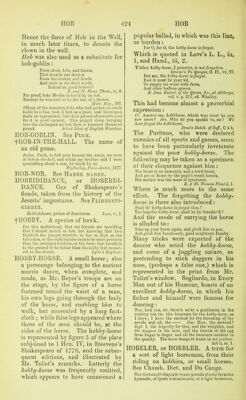
![And, His Hood! 1 would I might have once seene that, cliance. fHITCHER. A sort of boat-hook. And when they could not cause him to rise, one of them tooke a hitcher, or long boate-hooke, and hitch’d in the sicke mans breeches, drawing him backward. Taylor’s Workes, 1630. HO, s. Originally a call, from the in- terjection ho ! afterward rather like a stop or limit, in the two phrases, out of all ho, for out of all bounds ; and there’s no ho with him, that is, he is not to be restrained. Both seem deducible, in some degree, from the notion of calling in or restraining a sporting dog, or perhaps a hawk, with a call, or ho ; or so calling to a person at a distance, or going away. Oh, aye; a plague on’em, there’s no ho with them, they are madder than March hares. Honest Wh., 0. PI., iii, 353, See also 382. Because, forsooth, some odd poet, or some such fan- lastic fellows make much on him, there’s no ho with him ; the vile dandiprat will overlook the proudest of his acquaintance. Lingua, U. PL, v, 172. For he once loved the fair maid of Fresingfield out of all hoe. Green’s Fryer Bacon, fc., G 3. t Would not my lord make a rare player? oh, he would upholde a companie beyond all hoe, better then Mason among the kings players! Flay of Sir Thomas More. So also, Out of all cry, which see. There’s no ho with him; but once liartned thus, he will needes be a man of warre. Nash’s Lenten St.,Harl. Misc., vi, p. 160. If they gather together, and make a muster, there is no hoe with them. A Strange Metam., cited Cens. Lit., vii, 287. The phrase was retained even by Swift, in the jocular strain of his familiar letters : When your tongue runs, there’s no hoe with you, pray. Journ. to Stella, Let. 20. fAnd as the medley grew hote, such a sound there was of shields, such a clattering noyse also, as well of the men themselves as their weapons, making a dole- full din, as among whome there was now no hoe nor stay at all of their hands, that all the fields were covered over with bloud and slaine bodies lying along. Ammianus Marcellinus, 1609. tlnexplebile dolium ; hee hath no hoe with him. Withals’ Dictionary, ed. 1634, p. 560. \Phil. Must we still thus be check’d? we live not under a king, but a predagogue: bee’s insufferable. Leo. Troth he’s so proud now he must be kill’d to make a supper for the iinmortall canniballs, that there’s no ho with him. Cartwright’s Boyall Slave, 1651. HO, HO. An established dramatic ex- clamation, given to the devil, when- ever he made his appearance on the staim; and attributed to him when he was supposed to appear in reality. But Diccon, JDiccon, did not the devil cry ho, ho, ho ? Gammer Gnrtou, O. PL, ii, 34. Ho, ho, quoth the devyll, we are well pleased, Wliat is his name thou wouldst have eased. Ben Jonson’s comedy of the Devil is an Ass, begins with a long ho, ho, from Satan himself. Robin Good- fellow, a clown who often personates the devil, to scare his neighbours, in the old play of Wily Beguiled, speaks thus of his enterprise : Tush! fear not the dodge; I’ll rather put on my flashing red nose, and my flaming face, and come wrap’d in a calf’s skin, and cry ho, ho ; I’ll fray the scholar, I warrant thee. Origin of Dr., iii, 319. In that work it is indeed printed bo, bo, which alteration Mr. Hawkins made, I presume, from not being acquainted with the customary inter- jections of the fiend. In Mr. Reed’s notes to the Old Plays, it is cited ho, ho, which is probably right; but I have never had an opportunity of seeing the original play. HOAR, or HOARY. Used sometimes for mouldy, because mouldiness gives a white appearance. R. What hast thou found? M. No hare, sir; unless a hare, sir, in a lenten pye, that is something stale and hoar ere it be spent. Rom. and Jul., ii, 4. Many of Chaucer’s words are become as it were vinew’d and lioarie with over long lying. Beaum. to Speglit, on his Chaucer. Lest, starke with rest, they finew’d waxe and hoare. Mirror for Mag., p. 417. To HOAR. To become white or mouldy, or to make anything so. . Hoar the flamen That scolds against the quality of flesh, And not believes himself. Timon of Ath., iv, 3. When it hoars ere it be spent. Rom. and Jul., loc. cit. Devote to mouldy customs of hoar’d eld. Marston’s What you will, B 4. f To HOAST. To take up one’s abode with any one ; to have him for one’s host. See Host. If you would see the waters waving brine Abound with fishes, pray Hyperion T’abandon soon his liquid mansion, If he expect, in his prelixt career, To hoast with you a month in every yeer. Du Bartas. HOB. A frequent name, in old times, among the common people, particu- larly in the country. It is sometimes used, therefore, to signify a country- man ; and Ao6-goblin meant perhaps, originally, no more than clown-goblin, or bumpkin-goblin. Coriolanus, cu- riously enough, finds this name among the citizens of Rome : Why in this wolvish gown should I stand here, To beg of Hob, and Dick, that do appear Their needless vouches. Coriol., ii, 3. The country gnulfs [L e., gnoffs] Hob, Dick, and Hick, With staves and clouted shoon.](https://iiif.wellcomecollection.org/image/b24872180_0001_0437.jp2/full/800%2C/0/default.jpg)