Volume 1
A glossary, or, Collection of words, phrases, names, and allusions to customs, proverbs, etc., which have been thought to require illustration, in the works of English authors, particularly Shakespeare, and his contemporaries / [Robert Nares].
- Robert Nares
- Date:
- 1882
Licence: Public Domain Mark
Credit: A glossary, or, Collection of words, phrases, names, and allusions to customs, proverbs, etc., which have been thought to require illustration, in the works of English authors, particularly Shakespeare, and his contemporaries / [Robert Nares]. Source: Wellcome Collection.
446/494 (page 432)
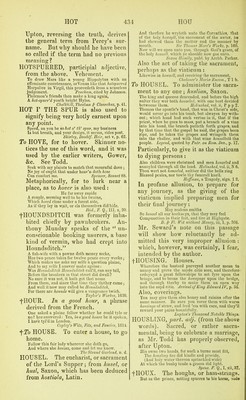
![Latimer shows how common it was so to feed horses : For when a man rideth by the way, and commeth to liisinne, and givetli to the hostler his horse to walk, and so himself sitteth at the table and maketli good cheere, and forgetteth his horse, the hostler cometh and saith, Sir, how much bread shall 1 give your horse ? Serm., fol. 153, b. These loaves, being large, became a jocular measure for the height of any very diminutive person : Her face was wan, a lean and writhel’d skin, Her stature scant three horse-loaves did exceed. Harringt. Ariosto, vii, 62. Minshew defines the word dwarf to mean “a dandiprat or elfe, one no higher than three horse-loaves.” So also Cotgrave, in Nain. Eye- bread is said to be given now to horses in Flanders. Cens. Lit., x, p. 369. tLastly for horse-bread, that three horse-loves be sold by the baker for a penie, xiiij.d. for xij. and every loafe to weigh the full weight. Dalton’s Countrey Justice, 1620. fHOESE-NIGHTCAP. A bundle of straw. Those that clip that they should not shall have a horse-night-cap for their labour. Penniles Parliament of Threed-hare Poets, 1608. HORT-YAED. A garden, now softened to orchard; from ortgeard, Saxon, which itself is put for wyrtgeard, a place for herbs. The hort-yard entering, admires the fair And pleasant fruits. Sandys, cited by Todd. HOSE. Breeches, or stockings, or both in one. Chausses, French. In French, distinguished into high hose and low hose: haut de cliausses, and has de chausses (as here, Upper and ne- ther stocks, which see) ; the present word has being only a contraction of the above. Hose are most probably derived from the Saxon hosa, though the Welch is nearly the same, and even the French not remote. In the following quotations hose evi- dently mean breeches, or the whole lower garment: And youthful still in your doublet and hose, this raw rlieumatick day. Merry W. IV., iii, 1. Their points being broken—down fell their hose 1 Hen. IV, ii, 4. 0, rhimes are guards on wanton Cupid’s hose. Disfigure not his slop. Love’s L. L., iv, 3. Slop is indeed an emendation of Theobald’s, but is indubitably right. Trunk hose were the round swelling breeches, such as are ridiculed in the following passage: Nay you are stronge men, els you could not beare these britches. IV. Are these such great hose? in faith, goodman collier, you see with your nose. By mine honestie I have but one lining in one hose, but 7 els of rug. Again: These are no hose, but water bougets, I tell thee playne; Good for none but suclie as have no buttockes. Dyd you ever see two suche little Robin ruddockes So laden with breeches ? chill say no more lest I olfende; Who invented these monsters first, did it to a godly ende, To have a male readie to put in other folke’s stuffe. Damon and Pithias, 0. PL, i, 219. A male is a trunk. Sometimes I have seene Tarlton play the clowne, and use no other breeches than such sloppes or slivings, as now many gentlemen weare; they are almost capable of a bushell of wheate, and if they bee of sacke-cloth they woulde serve to carrie mawlt to the mill. This absurde, clownish, and unseemly attire only by custome now is not misliked, but rather ap- proved. Wright’s Passions of the Minde, 1601, in Cens. Lit., ix, 178. [To make one’s heart sink into his hose, to terrify him.] IWlien 1 was hurte, then twenty more of those, I made the Romaynes harts to take their hose. Mirour for Magistrates, 1587. To HOST, from tbe substantive an host. To take up abode, to lodge. Go bear it to the Centaur, where we host. Com. of Er., i, 2. Come, pilgrim, I will bring you Where you shall host. All’s W., iii, 5. Also, to encounter with armies. In this sense Milton and Phillips have used it. See Johnson. An hosting pace, therefore, in Holinshed, means a fit pace for an onset in battle: The prince of Wales was ready in the field with hys people,—and advanced forward with them towarde his enimies, an hosting pace. Vol. ii, N n 3. [Also to receive the sacrament.] +He fell sick and like to die, whereupon he was shriven and would have been hosted, and he durst not for fear of casting. Scogin’s Jests, p. 27. HOSTRY. An inn ; from host. And now ’tis at home in mine hostry. Marlow’s Faustus, F 4, b. Dryden has used it, but it seems to be now obsolete. See Johnson. Also for a lodging in general: Only these marishes and myrie bogs, In which the fearful ewftes do build their bowres, Yeeld me an hostry ’mongst the croaking frogs, And harbour here in safety from those ravenous dogs. Spens. F Q., V, x, 23. tAnd yet at Lent assises anno Dom. 1621, sir James Ley delivered in his charge, that innes were hosieries, by the common law, and that every man might erect and keepe an inne or an hosterie, so as they were probi homines, men of good conversation, fame, and report, and dwelling in meet places. Dalton’s Countrey Justice, 1620. fNor are the men only expert herein, but the women and maids also, in their common hostries. Howell’s Familiar Letters, 1650. HOT. Called; used passively as the preterite of to hight.](https://iiif.wellcomecollection.org/image/b24872180_0001_0446.jp2/full/800%2C/0/default.jpg)