Volume 1
A glossary, or, Collection of words, phrases, names, and allusions to customs, proverbs, etc., which have been thought to require illustration, in the works of English authors, particularly Shakespeare, and his contemporaries / [Robert Nares].
- Robert Nares
- Date:
- 1882
Licence: Public Domain Mark
Credit: A glossary, or, Collection of words, phrases, names, and allusions to customs, proverbs, etc., which have been thought to require illustration, in the works of English authors, particularly Shakespeare, and his contemporaries / [Robert Nares]. Source: Wellcome Collection.
447/494 (page 433)
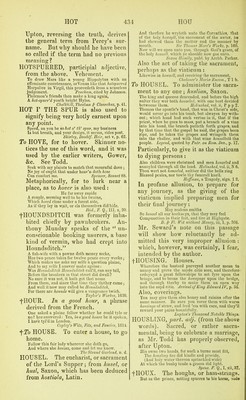
![Whylome before that cursed dragon got That happy land, and all with innocent blood Defyld those sacred waves, it rightly hot The well of life. ' Spens. F. Q., I, xi, 29. JSo also hote: And after him another knight that hote Sir Brienor, so sore that none him life behote. Ibicl., IV, iv, 40. Also for the past participle or pre- terite of to hit; A viper smitten or hot with a reed is astonied. Scot’s Discovery of Witchcraft, S 8. fHOTCHPOTCH. Bee. Nav,thatsplaine in Littleton, for if that fee-simple and thefee taile be put together, it is called hotch- potch; now this word hotch-potch in English is a pudding, for in such a pudding is not comonly one thing only, but one thing with another. Beturne from Pernassus, 1606, f HOT-COCKLES. An old game, prac- tised especially at Christmas, in which one person knelt down hoodwinked, and being struck behind, was to guess who inflicted the blow. It is often alluded to. To sit upon hot-cockles seems to mean here to be very im- patient. Hee laughs and kicks like Chrysippus, when hee saw an asse eat figs ; and sits upon hot-cocHes till it be blaz’d abroad, and withal intreats his neighbors to make bonefires for his good hap and causeth all the bels of the parish to ring forth the peal of his owne fame. Op tick Glasse of Humors, 1639. Sir Dot. What? why, here has been’the great devil, and all the little devils, at hot-cockles; and Belzebub and his dam at barly-break. World in the Moon, 1697- The Poets Hot Cockles. Thus poets passing time away, Like children at hot-cockles play; All strike by turn, and Will is strook, (And he lies down that writes a book) j Have at thee, Will, for now I come, Spread thy hand faire upon thy bomb, For thy much insolence, bold bard, And little sense, I strike thus hard. Whose hand was that? ’twas Jaspar Mayne; Nay, there you’re out, lie down again. With Gondibert, preface and all, See where the doctor comes to maul The author’s hand, ’twill make him reel, No, Will lies still and does not fee); That books so light, ’tis all one whether You strike with that, or with a feather. But room for one new come to town, That strikes so hard he’ll knock him down. The hand he knows, since it the place Has toucht more tender then his face ; Important sheriff, now thou lyst down. We’ll kiss thy hands, and clap our own. Certaine Verses written by severall of the Author’s friends, to be re-printed with the Second Edition of Gondibert, 1653, p. 23. ^HOT-HOUSE. A bagnio ; from the hot baths there used. They were of no better fame in early times than at present. See B. Jons. Epigrams, B. i, Ep. 7- Whose- house, sir, was, as they say, pluck’d down in the suburbs, and now she professes a hot-house, which is, I think, a very ill house too. Meas.for M., ii, 1, Besides, sir, you shall never need to go to a hot- house, you shall sweat there [at court] with courting your mistress, or losing your money at primcro, aa well as in all the stoves in Sweden. B. Jons. Every Man out of his II., iv, '8 Marry, it will cost me much sweat; I were better go to sixteen hot-houses. Puritan, iii, 6; Suppl. to Sh., ii, 598. Minshew renders hot-house by vapo- rarium, &c., and refers to Stew and Stove. [See Hummums.1 fHOTIES. These holy titles of bishop and priest are now grown odious among such poor sciolists who scarce know the hoties of things, because they savor of antiquity. Howell’s Familiar Letters, 1650. fHOT-SHOTS appear to have been a class of soldiers, perhaps skirmishers. In the reareward comes captaine Crab, lieutenant Lobster, (whose catching clawes alwayes puts me in minde of a sergeant) the blushing prawne, the well- armed oyster, the scollop, the wilke, the mussel\ cockle, and the perewinkle; these are hot-shots, veneriall provocators, fishy in substance, and fleshly in operation. Taylor’s Workes, 1630. When those inferior princes houses are guarded with hungry halberdiers, and revvrend rusty bil-men, with a brace or two of hot-shots; so that their pallaces are more like prisons, then the free and noble courts of commanding potentates. Ibid. HOTSPUR, adj. and s. Warm, vehe- ment; or as an appellation for a per- son of vehement and warm disposi- tion, and therefore given to the famous Harry Percy. A very violent rider makes his spurs hot in the sides of his horse. This is evidently the allusion. In the following passage it has the general sense, as well as that of a conventional name : My nephew’s trespass may be well forgot. It hath th’ excuse of youth, and heat of blood; And an adopted name of privilege,— An havebrain’d Hotspur, govern’d by a spleen. 1 Hen. IV, v, 2. After Percy is killed, it is said, in allusion to his surname, that his spur is cold: He told me that rebellion had bad luck. And that young Harry Percy’s spur was cold. 2 Hen. IV, i, 1. And directly after, Ha—again, Said he young Harry Percy’s spur urns cold ? Of Hotspur, cold-spur ? Ibid. Spenser uses it as an adjective : The hot-spurre youth, so scorning to be orost. F. Q., IV, i, 35. Harvev as a substantive : Cormorants and drones, dunces, and hypocriticall hotspurres. Gabr. Harv. Four Letters, E 4, b. Stanyhurst, in his translation of four books of Virgil: To couch not mounting of master vanquisher hoat- spur. Where vanquisher hoatspur is the ver- sion of victoris heri. Wars are begun by hairbrained dissolute captains, parasitical fawners, unquiet hotspurs, and restless innovators. Burton, cited by Johnson, 28](https://iiif.wellcomecollection.org/image/b24872180_0001_0447.jp2/full/800%2C/0/default.jpg)