Volume 1
A glossary, or, Collection of words, phrases, names, and allusions to customs, proverbs, etc., which have been thought to require illustration, in the works of English authors, particularly Shakespeare, and his contemporaries / [Robert Nares].
- Robert Nares
- Date:
- 1882
Licence: Public Domain Mark
Credit: A glossary, or, Collection of words, phrases, names, and allusions to customs, proverbs, etc., which have been thought to require illustration, in the works of English authors, particularly Shakespeare, and his contemporaries / [Robert Nares]. Source: Wellcome Collection.
450/494 (page 436)
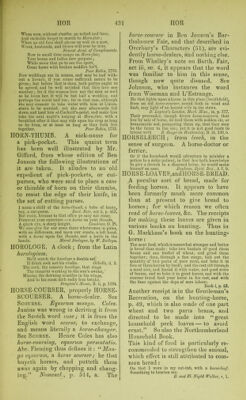
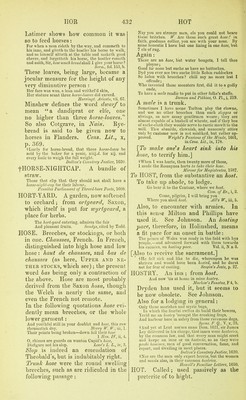
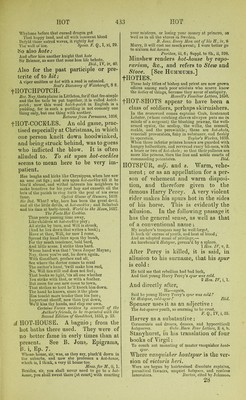
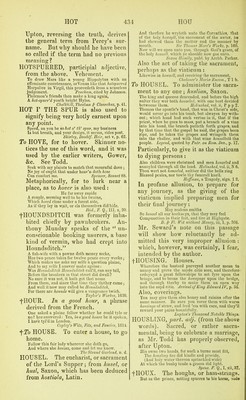
![wit'll fancie, account all honest recreation mere follie, and having taken a surfet of delight, seem now to savour it with despight. Eupliues, C 3, b. •fHUDDLB. A confused heap. I was obliged to go a little out of my way, to see the famous Stone-henge, one of the wonders of England, and which none of their authors know what to make of; it is a great huddle of large stones, placed in a circular form; some of them thirty foot high, and some laid a-cross on the tops of others. Journey through England, 1724. As an adj., heaped confusedly. A suddain, huddle, indigested thought Howls in my brain——’tis the safest method . The Revengeful Queen, 1698 +HUDLED-UP. Hushed up. The matter was hudled up, and little spoken of it. Wilson's Life of James 1, 1653, p. 285. fTo HUFF. To swagger. The smell is the senting bawd, that huffs and snuffs up and downe, and hath the game alwayes in the wiude. Taylor's Workes, 1630. One asked a huffing gallant why hee had not alooking- glasse in his chamber; he answered, he durst not, because hee was often angry, and then he look’d so terribly that he was fearelull to looke upon himselfe. Ibid. Flou'rd. Iniquity aboundeth, though pure zeal Teach, preach, huffe, puffe, and snuffe at it, yet still. Still it aboundeth.* Randolph's Muses Looking-Glasse, 1643. And the same threats and menaces of the palatine being carry’d to the marshal de Tonueure, notwith- standing all his former encomiums, Oli! quo he, the palatine’s a young prince; give him leave to huff and ding for his living; words break no bones : when all’s done, ’tis the coach wheel, not the fly that raises the dust. The Pagan Prince, 1690. Pray neighbour, why d’ye look awry? You’re grown a wondrous stranger; You huff, you pout, you walk about As tho’ you’d burst with anger. Newest Academy of Compliments, 1714. HUFFCAP. A cant term for strong ale ; from inducing people to set their caps in a bold and huffing style. To quench the scorching heat of our parched throtes, with the best nippitatum in this town, which is com- monly called hufcap, it will make a man looke as though lie had seene the devill, and quickely move him to call his own father hoorson Fulwel’s Art of Flattery, H 3. tThere’s one thing more I had almost forgot. And this is it, of ale-houses, and lunes, Wine-marchants, vintners, brewers, who much wins By others losing, I say more or lesse Who sale of hufcap liquor doe professe. Taylor's Workes, 1630. lA1so, a swaggerer.] IBut ’tis a maxime mortals cannot hinder, The doughty deeds of Wakefields huffe-cap pinder Are not so pleasant as the faire Aurora, When Nimrod rudely plaid on his bandora. Ibid. tPrethee tell me true, was not this huff-cap once the Indian emperour, and at another time did not he cail himself Maximine ? Clifford's Notes upon Dryden, 1687. 'j'HUFFER. A swaggerer. Welcome mask-teazer, peevish gamster, huffier; All fools, but politicians, we can suffer. Vertue Betray’d, 1682. fHUFFRING. Swaggering, from buf- fer ; or perhaps a misprint for huffing. And all before it will be overborn, Before its blustring blasts Hie to the shores WTtli mightie hi ffiring, puffing, rumbling roares. Virgil, by Vicars, 1632. HUFF-SNUFF. A fierce, bullying person ; from huff and snuffy both denoting anger. See Snuff. Those roaring hectors, free-booters, desperadoes, and bullying huff-snuffs, for the most part like those whom Tacitus stiles, “ hospitibus tantum metuendi.” Ozell’s Rabelais, vol. iv, Pref., xxiii. fHUFTY. A swagger. Hence hufty- tufty. Cut their meat after an Italian fashion, weare their hat and feather after a Germaine hufty. Melton, p. 52. Master Wyldgoose, it is not your huftie tuftie can make mee afraid of your bigge lookes. Breton's Paste with a Packet of Mad Letters, 1637. fHUGEOUSLY. For hugely; very greatly. A favorite word in the 17th century. Catch. To satisfie you In that point, we will sing a song of his. And. Let’s lia’t; I love these ballads liugeously. Cartwright's Ordinary, 1651. In HUGGER-MUGGER. In secrecy, or concealment. For the various de- rivations, see Todd. But I am in- clined to think that they are all erro- neous, and that the different spellings are founded on similar mistakes; while the word was really formed from hug, or hugger, by a common mode of burlesque reduplication. Steevens found to hugger, for to lurk about. The phrase in hugger-mugger is now obsolete; the word is used, if at all, as an adjective, as, hugger- mugger doings; or an adverb, as, it wus all carried on hugger-mugger. And we have done but greenly In hugger-mugger to inter him. ILaml., iv, 5. And how quaintly he died, like a politician, in hugger- mugger. Revenger's Trag., 0. PI., iv, 395. See also 0. PI., viii, 48. One word, sir Quintilian, in hugger-mugger. Satiromastix, Orig. of Or., iii, 133. For most that most things knew, In hugger-mugger utter’d what they durst. Mirror for Mag., p. 457. So these perhaps might sometimes have some furtive conversation in hugger mugger. Coryat, Crud., ii, p. 251, repr. In old books, I do not find the phrase in any other form ; but the common- ness of it in that usage strongly proves the rashness of some editors of Shake- speare, who thought proper to change it. Asoham writes it hudder-mother, pro- bably from some assumed notion of its etymology : It lurkes not in corners, and hudder-mother. Toxophilus, p. 19, repr. \_Huggle-duggle is used in somewhat the same sense.]](https://iiif.wellcomecollection.org/image/b24872180_0001_0450.jp2/full/800%2C/0/default.jpg)