Volume 1
A glossary, or, Collection of words, phrases, names, and allusions to customs, proverbs, etc., which have been thought to require illustration, in the works of English authors, particularly Shakespeare, and his contemporaries / [Robert Nares].
- Robert Nares
- Date:
- 1882
Licence: Public Domain Mark
Credit: A glossary, or, Collection of words, phrases, names, and allusions to customs, proverbs, etc., which have been thought to require illustration, in the works of English authors, particularly Shakespeare, and his contemporaries / [Robert Nares]. Source: Wellcome Collection.
480/494 (page 466)
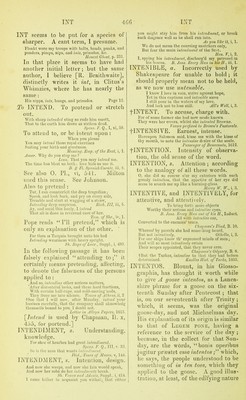
![INT seems to be put for a species of sharper. A caut term, I presume. Flankt were my troups with bolts, bauds, punks, and panders, pimps, nips, and hits, prinados, &c. Honest Ghost, p. 231. In that place it seems to have had another initial letter ; but the same author, I believe [R. Braitliwaite], distinctly writes it int, in Clitus’s Wliimzies, where he has nearly the same : His nipps, hits, bungs, and prinados. Page 12. To INTEND. To protend or stretch out. With sharp intended sting so rude him smott, That to the earth him drove as striken dead. Spens. F. Q., I, xi, 88. To attend to, or be intent upon : When you please You may intend those royal exercises Suiting your birth and greatness. Massing. Em/p. of the East, i, 1. Amar. Why do you stop me ? Lean. That you may intend me. The time has blest us both: love bids us use it. B. f FL Spanish Curate, iii, 4. See also 0. PI., vi, 541. Milton used this sense. See Johnson. Also to pretend : Tut, I can counterfeit the deep tragedian; Speak, and look back, and pry on every side, Tremble and start at wagging of a straw, Intending deep suspicion. Rich. Ill, iii, 5. Ay, and amid this burly, I intend That all is done in reverend care of her. Tam. of Slir., iv, 1. Pope reads “ I’ll pretend,” wrhicli is only an explanation of the other. For then is Tarquin brought unto his bed Intending weariness with heavy spright. Sh. Rape of Liter., Suppl., i, 480. In the following passage it has been falsely explained “ attending to;” it certainly means pretending, affecting, to denote the falseness of the persons applied to: And so, intending other serious matters, 'After distasteful looks, and these hard fractions, With certain half-caps, and cold-moving nods, They froze me into silence. Timon of Athens, ii, 2 tSoe that 1 will now, after Munday, intend your busines carefully, that the company shall aknowledg themselfs bound to you, I doubt not. Letter in Alleyn Papers, 1613. [Intend is used by Chapman, II. x, 455, for portend.] INTENDIMENT, s. Understanding, knowledge. For shee of hearbes had great intendhnent. Spens. F. Q., Ill, v. 32. So is the man that wants intendhnent. Ibid., Tears of Muses, v, 144. INTENDMENT, s. Intention, design. And now she weeps, and now she fain would speak, And now her sobs do her intendments break. Sh. Venus and Adonis, Suppl., i, 414. I came hither to acquaint you withal; that either you might stay him from his intendment, or brook such disgrace well as lie shall run into. As you lilce it, i, 1. We do not mean the coursing snatchers only. But fear the main intendment of the Scot. Hen. V, i, 2. I, spying his intendment, discharg’d my petronel in his bosom. B. Jons. Every Man in his H., iii, 1. INTENIBLE, a. Incorrectly used by Shakespeare for unable to hold; it should properly mean not to be held, as we now use untenable. I know I love in vain, strive against hope, Yet in this captious and intenible sieve I still pour in the waters of my love, And lack not to lose still. All’s Well, i, 3. f INTENT. To accuse, charge with. For of some former she had now made known They were her errors, whilst she intented Browne. Verses prefixed to Brown’s Pastorals. ^INTENSIVE. Earnest, intense. Hereupon Salomon said, kisse me with the kisse of thy mouth, to note the intensive desire of the soule. Passenger of Benvenuto, 1612. ^INTENTION. Intensity of observa- tion, the old sense of the word. INTENTION, s. Attention ; according to the analogy of all these words. 0, she did so course o’er my exteriors with such greedy intention, that the appetite of her eye did seem to scorch me up like a burning-glass. Merry W. W., i, 3. INTENTIVE, and INTENTIVELY, for attentive, and attentively. To bring forth more objects Worthy their serious and intentive eyes. B. Jons. Every Man out of his II, Induct. All with intentive ear, Converted to the enemies’ tent s. Chapman’s Iliad, B. 10. Whereof by parcels she had someihing heard, But not intentively. Othello, i, 3. For our ships know tli’ expressed minds of men; And will so most intentively retain Their scopes appointed, that they never erre. Chapman’s Odyssey, B. 8. IBut the Turkes, intentive to that they had before determined. Knolles Hist, of Turks, 1603. INTENTOS. Blount, in his Glosso- graphia, has thought it worth while to give A goose mtentos, as a Lanca- shire phrase for a goose on the six- teenth Sunday after Pentecost ; that is, on our seventeenth after Trinity ; which, it seems, was the original goose-dav, and not Michaelmas day. His explanation of its origin is similar to that of Legem pone, having a reference to the service of the day ; because, in the collect for that Sun- day, are the words, “ bonis operibus jugitur prsestet esse intentoswhich, he says, the people understood to be something of in ten toes, which they applied to the goose. A good illus- tration, at least, of the edifying nature](https://iiif.wellcomecollection.org/image/b24872180_0001_0480.jp2/full/800%2C/0/default.jpg)