Volume 1
A glossary, or, Collection of words, phrases, names, and allusions to customs, proverbs, etc., which have been thought to require illustration, in the works of English authors, particularly Shakespeare, and his contemporaries / [Robert Nares].
- Robert Nares
- Date:
- 1882
Licence: Public Domain Mark
Credit: A glossary, or, Collection of words, phrases, names, and allusions to customs, proverbs, etc., which have been thought to require illustration, in the works of English authors, particularly Shakespeare, and his contemporaries / [Robert Nares]. Source: Wellcome Collection.
484/494 (page 470)
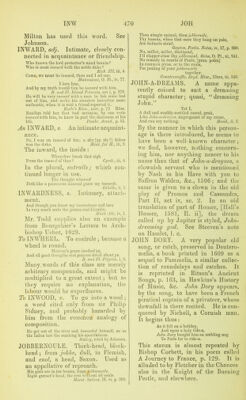
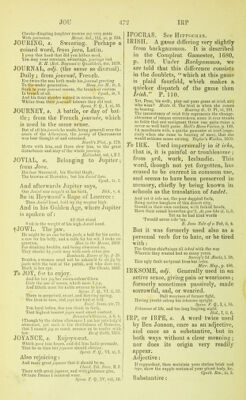
![Milton lias used this word. See Johnson. INWARD, adj. Intimate, closely con- nected in acquaintance or friendship. Wlio knows the lord protector’s mind herein? Who is most inward with the noble duke ? Rich. Ill, iii, 4. Come, we must be inward, thou and I all one. Malcontent, 0. Ph, iv, 77. I love him. And by my troth would fain be inward with him. B. and FI. Island Princess, act i, p. 276. He will be very inward with a man to fish some bad out of him, and make his slanders hereafter more authentic, when it is said a friend reported it. Earle’s Micr., xxiv, p. 72 Bliss. Basilius told her that bad occasion, by one verie inward with him, to know in part the discourse of his life. Pembr. Arcad., p. 55. An INWARD, s. An intimate acquaint- ance. Sir, I was an inward of his: a shy [qy. sly?] fellow wus the duke. Meas.for M., iii, 2. The inward, the inside : Wherefore break that sigh Prom the inward of thee ? Cymb., iii, 4 In the plural, entrails; which con- tinued longer in use. The thought whereof Doth like a poisonous mineral gnaw my inwards. Othello, ii, 1. INWARDNESS, s. Intimacy, attach- ment. And though you know my inwardness and love Is very much unto the prince and Claudio. Much Ado, iv, 1. Mr. Todd supplies also an example from Bourgchier’s Letters to Arch- bishop Usher, 1629. To INWHEEL. To encircle ; because a wheel is round. Heaven’s grace inwheel ye, And all good tliougtlis and prayers dwell about ye. B. and FI. Pilgrim, i, 2. Many, words of this class are merely arbitrary compounds, and might be multiplied to a great extent; but as they require no explanation, the labour would be superfluous. To INWOOD, v. To go into a wood ; a word cited only from sir Philip Sidney, and probably hazarded by him from the comrfion analogy of composition. He got out of the river and inioooded himself, so as the ladies lost the marking his sportfulness. Sidney, cited by Johnson. JOBBERNOULE. Thick-head, block- head ; from jobbe, dull, in Flemish, and cnol, a head, Saxon. Used as an appellative of reproach. His guts are in bis brains, hugo jobbernoule, ltight gurnet’s head, the rest without all soule. Marst. Satires, II, vi, p. 200. Thou simple animal, thou jobbernole, Thy basons, when that once they hang on pole, Are helmets strait. Gayton, Festiv. Notes, iv, 17, p. 260. No, miller, miller, dustipoul, I’ll clapper-claw thy jobbernoul. Grim, O. PI., xi, 241. No remedy in courts of Pauls, [pron. poles] In common pleas, or in the rouls, For jouling of your jobbernovls together. Countersctiffle, Dryd. Misc., 12mo, iii, 340. JOHN-A-DREAMS. A name appa- rently coined to suit a dreaming stupid character; quasi, “ dreaming John.” Yet I, A dull and muddy-mettled rascal, peak, Like John-a-drearns, unpregnant of my cause, And can say nothing. Rami., ii, 2. By the manner in which this person- age is there introduced, he seems to have been a well-known character; we find, however, nothing concern- ing him, nor anything nearer to his name than that of John-a-droynes, a clownish servant who is mentioned by Nash in his Have with you to Saffron Walden, &c., 1596; and the same is given to a clown in the old play of Promos and Cassandra, Part II, act iv, sc. 2. In an old translation of part of Homer, [Hall’s Homer, 1581, II. ii], the dream called up by Jupiter is styled, John- dreaminy god. See Steeven’s note on Hamlet, 1. c. JOHN DORY. A very popular old song, or catch, preserved in Deutero- melia, a book printed in 1609 as a sequel to Pammelia, a similar collec- tion of roundelays and catches. It is reprinted in Ritson’s Ancient Songs, p. 163, in Hawkins’s History of Music, &c. John Dory appears, by the song, to have been a French piratical captain of a privateer, whose downfall is there recited. He is con- quered by Nicholl, a Cornish man. It begins thus: As it fell on a holiday, And upon a holy tide-a, John Dory bought him an ambling nag To Paris for to ride-a. This stanza is almost repeated by Bishop Corbett, in his poem called A Journey to France, p. 129. It is alluded to by Fletcher in the Chances also in the Knight of the Burning Pestle, and elsewdiere.](https://iiif.wellcomecollection.org/image/b24872180_0001_0484.jp2/full/800%2C/0/default.jpg)