Volume 1
A glossary, or, Collection of words, phrases, names, and allusions to customs, proverbs, etc., which have been thought to require illustration, in the works of English authors, particularly Shakespeare, and his contemporaries / [Robert Nares].
- Robert Nares
- Date:
- 1882
Licence: Public Domain Mark
Credit: A glossary, or, Collection of words, phrases, names, and allusions to customs, proverbs, etc., which have been thought to require illustration, in the works of English authors, particularly Shakespeare, and his contemporaries / [Robert Nares]. Source: Wellcome Collection.
485/494 (page 471)
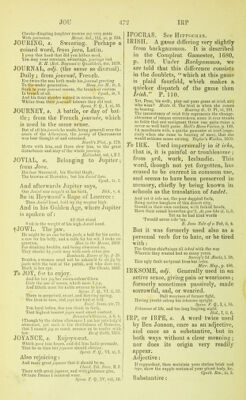
![Being as worthy to sit, On an ambling tit, As thy predecessor Dory. Denh. Ballad on Sir John Mennis, Works, p. 74. The tune, too, was in favour as a county dance: Hunger is the greatest pain he [the fiddler] takes, except a broken head sometimes, and labouring John Durye. Microcosm, p. 170. Bliss’s edition. + Where I’ll tell you (while none mind us) We throw th’ house quite out at windows; Nought makes them or me ought sorry, They dance lively with John Dory: Holy bfethren with their poet Sing, nor care they much wdio know it. Drunken Barnaby. tThen viscount Slego telleth a long storie Of the supplie, as if hee sung John Dorie. Kerry Pastorals. fJOHN-A-NOAKES, seems to have been a popular name for a simple clown. Then have I attended five or six houres (like John-a- Noakes) for nothing, for my cheating sharke having neither money nor honesty, hath never come at mee, but tooke some other paire of stayres, and in the same lasliiou coozened another water-man for his boat-hire. Taylor’s Workes, 1630. John a Nokes was driving his cart toward Croydon, and by the way fell asleepe therein. Meane time a good fellow came by and stole away his two horses, and went faire away with them. In the end he awaking and missing them, said. Either I am John a Nukes, or I am not John a Nokes. If I am John a Nokes then have I lost twvo horses, and if 1 be not John a Nokes, then have I found a cart. Copley’s Wits, Fits, and Fancies, 1614. •f JOIIN-HQLD-MY-STAFF. A sub- servient person ; a parasite. And here it is the fortune of a man to be married to a woman of so peevish and domineering a temper that she will wrear the breeches and the cap too: so that the poor fop at home is like John-Hold-my-stuff; she must rule, govern, insult, brawl, &c. Fifteen Comforts of Matrimony, n. d. JOHN, SWEET. A flower of the pink kind. Sweet Johns and sweet williams are given by Gerard as different species of armeria. The former are divided into white, and red and white ; the latter are spoken of in this passage, after speaking of gelofers and pinks : Thejohn, so sweete in show'e and smell, Distincte by colours twaine. About the borders of their beds In seemelie'sight remaine. Plat’s Flowers, in Cens. Lit., viii, p. 3. See Johnson’s Gerard (1636), p. 597. The name of Sweet Williams still remains. The johns, according to the cut in Gerard, are not so closely clustered. See also Gilloeer. f JOINED-WORK. An old term for wainscoting. Opere intestino vestire parietes. Lambrisser. To cover wals with wainscot or joyned ivorke, Nomenclator. JOINT-RING. Probably a ring with %/ O joints in it. Othelloy iv, 3. See Gimmal. JOINT-STOOL, prov. Cry you mercy, I took you for a joint-stool! This odd proverb seems to have been intended as a ridiculous instance of making an offence worse by a foolish and improbable apology ; or, perhaps, merely as a pert reply, when a person was setting forth himself, and saying who or what he was. The fool uses it in King Lear, in the following manner : F. Come hither, mistress, is your name Goneril ? Lear. She cannot deny it. F. Cry you mercy, I took you for a joint-stool. Lear, iii, 6. Where, possibly, poor Lear, in his insanity, was intended literally to mistake joint-stool for his daughter. It is alluded to also by Kate, in the Taming of the Shrew, who, when Petruchio asks her what she means by a moveable ? replies, “ a joint- stool.” Tam. Shr., ii, 1. Ray has it among his Proverbs, p. 202, but without any explanation. It occurs also in Lyly’s Mother Bo ru- ble, act iv, sc. 2. JOINTRESS, s. One who holds a jointure. Our queen Imperial jointress of this warlike state. Hand., i, 2. JORNET, s. Apparently a kind of cloak. Constables, the one lialfe—in bright harnesse, some over gilt, and every one a jornet of scarlet thereupon, and his henchman following him. Stowe’s London, 1590, p. 75. \To JOSSEL. The old manner of spelling jostle. The weight of business lying on him, might make him incounter him with some miscarriages through youth and ignorance (great imployments often meeting with envy, and jossels them in the way. Wilson’s James I. JOUISANCE, s. Enjoyment; but written by Spenser jovysaunce. It is one of the antiquated words which that poet particularly introduces into his pastorals ; judging properly that old words are retained in provincial dialects much longer than in polished speech. To see those folks make jovysaunce. Made my heart after the pipe to daunce. Step. Kal., May, v, 25, He uses it again in November, v, 2.](https://iiif.wellcomecollection.org/image/b24872180_0001_0485.jp2/full/800%2C/0/default.jpg)