Content advisory
This digitised material is free to access, but contains information or visuals that may:
- include personal details of living individuals
- be upsetting or distressing
- be explicit or graphic
- include objects and images of objects decontextualised in a way that is offensive to the originating culture.
Licence: In copyright
Credit: W Ford Doolittle. Source: Wellcome Collection.
7/23
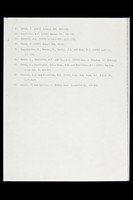
![of eukaryotic cells, since such hypotheses virtually require that the entire eukaryotic cell be of relatively recent blue-green algal (eubacterial) origin [17,18]. Endosymbiotic hypotheses, which most data now support, are less specific about the origin of the nuclear-cytoplasmic component, although most consider it to be eubacterial [19]. There is no compelling evidence to support such an origin. Differences in genetic organization and expression between the nucleus and prokaryotes (specifically eubacteria, since little is known about the molecular biology of archaebacteria [14]) have been recognized for a long time. It was until recently customary to explain them as an adaptation to the genomic compartmentalization which defines the eukaryotic condition, and to view eukaryotic genomes as advanced descendants of prokaryotic genomes. The recent discovery [20,21] that genes in prokaryotes and genes in eukaryotes can differ in a very fundamental way - those in prokaryotes being intact and colinear with protein; those in eukaryotes being inter rupted by intervening sequences which complicate the process of gene expression in a way which cannot yet be seen as selectively advantageous - prompted a re-examination of this notion. I argued [22] that it was easier to imagine intervening sequences as relics of a very primitive stage in cellular evo lution, which have been eliminated in prokaryotic lineages but retained in nuclear- cytoplasmic lineages, than it is to imagine their introduction during the prokaryote: eukaryote transition. Darnell [23] pointed out that many other differences between nuclear-cytoplasmic and eubacterial molecular biologies (such as the paucity of opérons, the possession of multiple RNA polymerases and the extensive post-transcriptional processing and modification of messenger RNAs) are so profound as to suggest that sequential prokaryote to eukaryote](https://iiif.wellcomecollection.org/image/b18175740_PP_CRI_H_6_13_5_0007.jp2/full/800%2C/0/default.jpg)

 No text description is available for this image
 No text description is available for this image
 No text description is available for this image