Abridgments of the specifications relating to preservation of food / printed by order of the Commissioners of Patents.
- Date:
- 1857
Licence: Public Domain Mark
Credit: Abridgments of the specifications relating to preservation of food / printed by order of the Commissioners of Patents. Source: Wellcome Collection.
29/62 page 21
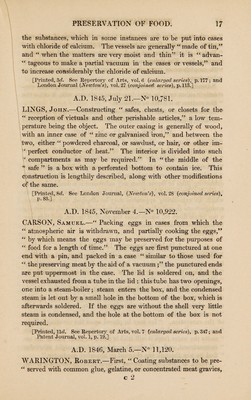
![A.D. 1847, October 7.—N° 11,892. LIGNAC, Jules Jean Baptiste Martin de.—“Evaporat- ££ ing, and then storing and closing milk in vessels so as more effec- ££ tually to preserve the same than has heretofore been accomplished.”’ The milk, after straining, is evaporated in large flat shallow pans, heated by a steam bath to 186° Fahrenheit, to about one-sixth of its bulk, and then filled into tin vessels, which are hermetically sealed after standing twenty-four hours. These tins, when sealed, are put into water at a temperature of 210° Fahrenheit, and ££ remain at that ££ temperature for ten minutes.” [Printed, Is. Id. See London Journal {Newton's), vol. 32 {conjoined series),. p. 246.] A.D. 1847, November 6.—N° 11,947. DAVISON, Robert, and SYMINGTON, William.—Applying heat to the preparation, desiccation, and preservation of bread stuffs, confectionary, pulse, meats, vegetables, and other edible substances : First, To prevent the temperature of the air fluctuating in the oven described in a former Patent, some pipes and valves are to be added to it. Second, Substituting for the ordinary bakers’ oven, one heated by rapid currents of air; and another chamber may be built over it “ for substances not requiring so high a degree of heat for their ££ preparation.” Third, Roasting ££ coffee, chicory, cocoa, barley,” &c., in revolv¬ ing cylinders, with small holes for the admission of heated air, and with cavities of a U form. Fourth, Drying vegetables, &e., ££ upon trays with hair cloth or ££ lattice-work bottoms,” “ one above another in the heating cham- ££ ber.” When they are large, they are first cut into slices. Fifth, Drying meat by cutting in thin slices and hanging it up in the drying oven until it ceases to lose weight. Sixth, Mixing ££ yolks and whites of eggs ” ££ with flour, ground ££ rice, or other faranaceous substance,” and drying, and ££ when tho- £C roughly dry (the cakes are) reduced to the state of flour, and in ££ that state packed up for use.” Instead of mixing the yolks and whites, they may be preserved separately. [Printed, lOcZ. See London Journal {Newton's), vol. 36 {conjoined series), p.I27; Mechanics’ Magazine, vol. 43, p.457; and Patent Journal, vol. 4, p. 624, and vol. 8, p. 266.1](https://iiif.wellcomecollection.org/image/b30471345_0029.jp2/full/800%2C/0/default.jpg)


 No text description is available for this image
 No text description is available for this image
 No text description is available for this image