Abridgments of the specifications relating to preservation of food / printed by order of the Commissioners of Patents.
- Date:
- 1857
Licence: Public Domain Mark
Credit: Abridgments of the specifications relating to preservation of food / printed by order of the Commissioners of Patents. Source: Wellcome Collection.
31/62 page 23
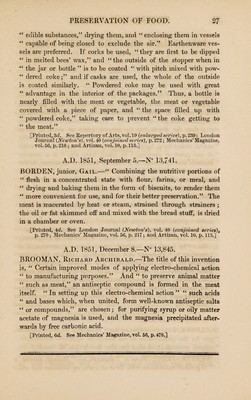
![“ All kinds of malt liquors and wines” are preserved by putting them into strong small barrels or vessels made of metal, well tinned, and strong enough to bear a pressure of from 60 to 80 pounds to the square inch ;” “ compressed carbonic acid gas ” is “ forced into the liquid.” Milk or cream is preserved “ by first scalding it and then im~ “ pregnating it with carbonic acid gas in a soda-water machine.” “ After the milk is charged with the gas, it is drawn off into bottles “ and corked in the usual way, or into metal barrels, cases, jars,” &c.; or the milk, after scalding, is treated like the malt liquors above. [Printed, 10c7. See London Journal (Newton’s), vol. 35 fconjoined series)T, p. 25; Mechanics’ Magazine, vol. 50, p. 187; Artizan, vol. '7, p. 208 ; and Patent Journal, vol. 6, p. 225.] A.D. 1848, December 21.—N° 12,381. TRAVIS, John, and MTNNES, John.—Packing lard in “ a “ suitable woven fabric,” which may be “ closely-woven calico or “ muslin.” The package is made to resemble in shape “ the- “ bladder now in general use.” It may be coated, and a coat¬ ing well adapted is said to be made by mixing “ animal gelatine “ with farina or starch paste;” after dipping in this solution, it is again “ dipped into a saturated solution of common salt and “ alum.” [Printed, 3c?. See London Journal {Newton's), vol. 35 {conjoined series),. p. 34; Mechanics’ Magazine, vol. 50, p. 619; and Patent Journal, vol. 7, p. 131.] A.D. 1849, March 28.—N° 12,548. BRITTEN, John.—First, “ Constructing kitchen ranges with “ an inner mantel shelf projecting partially over the fire,” witb doors down to the hobs, “ so as to form, when the doors are open, “ a sort of bonnet to prevent the chimney from smoking.” Second, Constructing ovens which “ are heated by a top and a “ bottom draft directly from the fire,” with “an additional damper “ or door to shut off the top draft without closing the bottom “ one.” Third, Heating ovens “ by combining the ordinary bottom ‘ draft from the fire with a circulation of hot air,” to avoid the- necessity of “ a hollow top.” Fourth, Heating air by means of “ a hollow cheek between the oven and the fire.”](https://iiif.wellcomecollection.org/image/b30471345_0031.jp2/full/800%2C/0/default.jpg)



 No text description is available for this image
 No text description is available for this image
 No text description is available for this image