Sales catalogue 180 International Antiquariaat
- Date:
- 20th century
- Reference:
- WA/HMM/CM/Sal/38/5
Licence: Public Domain Mark
Credit: Sales catalogue 180 International Antiquariaat. Source: Wellcome Collection.
25/196 page 9
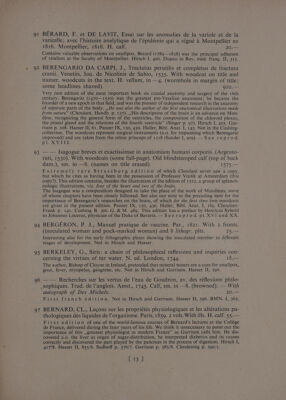
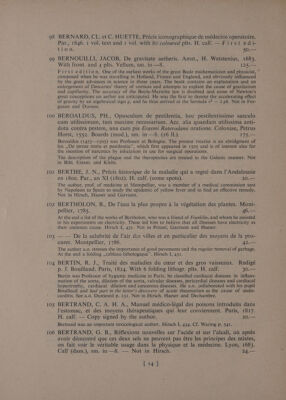
![58 you 60 61 62 63 BARTHEZ, BOUVART, FOUQUET, LORRY ET ‘LAMURE, Consultations de médicine. Paris, 1807. 2 vols. H. calf (dam.). 30.— We have not been able to trace this work in any of the bibliographies we were able to consult. About the authors see a.o. Hirsch I, 307—10, I, 546, Il, 413, IV, 43 and III, 593. BARTHOLINUS, TH., Epistolarum medicinalium centuria I(—II). Hagae- Com., 1740. 2 vols. With ills. Calf, sm. in —8. 36.— Bartholinus (1616—1680) discovered the intestinal lymphatics and their connection with the thoracic duct. The present collection also contains letters written to him by such scientists as Licetus, Harvey, Bauhinus, Lod. Kepler, Veslingius, Worm, Beverwyck, Pecquet, a.o. Garrison, p. 246. Haeser II, 305. Hirsch I, 312. Choulant, BMH. p. 75. Without the third part, which appeared separately. BMN. p. 76. —- Anatomia reformata. Acc. appendix de lacteis thoracicis et vasis lym- phaticis. Hagae-Com., 1655. With curious engr. front., portrait by Carel van Mander and numerous fine anatomical plates. H. calf (19th cent.). 48.— The illustrations are after Vesalius, Casserius, Vesling a.o. This ed. not in Choulant, p. 245/7. Cf. Sudhoff p. 278. Cushing p. 150. B.M.N. p. 80. — — Historiae anatomicae rariores. Centuriae I—IV. Acc. eiusdem obser- vationes anatomicae Petri Pawi. Hagae-Com., 1657. In 1 vol. (The observations by Pawus with separate title and pagination). With 2 engr. titles, portr., 15 plts. and woodcut ills. in the text. Calf (back dam.), sm. in ries (name of former owner on title erased). 45.— Firsit-. 6 diti om “Mitsceh I5-91t/72:-Haeser Il, 276/7.: Garrison’ p.. 246. BARTISCH, GEORGE, Ogfaducdoviea, das ist Augendienst. Newer und wolgegriindter Bericht von Ursachen und Erkentnus aller Gebrechen, Schaden u. Mangel der Augen u. des Gesichtes, wie man solchen anfenglich mit gebur- lichen Mitteln begegnen, vorkommen u. wehren. Auch wie man alle solche Gebresten kiinstlich diirch Artzney, Instrument und Handgrieffe curiren, wir- cken und vertreiben soll. Desgleichen von kunstlichen Praeparationen, Pur- gationen, calcinationen, ... zur Augenartzney notig u. niitzlich. Dresden, M. Stockel, 1583. With woodcut title-border (cropped and mounted), 2 woodcut coats-of-arms, portrait of Bartisch and 88 woodcuts (of which 2 movable), all coloured by a contemporary hand. Old blindstamped calf over wooden boards, sm. in —folio. (Several spots and a large stain on p. 221/2; one small movable part of one plate lacking). 1800.— The first edition of the first work dealing with ophthalmology and the special diseases of the eye. The anatomical woodcuts are copies after Vesalius, but all woodcuts of the anatomy of the eye, the surgical instruments, etc., were made after drawings of Bartisch himself. Of great interest are also the chapters on the mouth, the teeth, the skin, etc., as relating to the eyes. For the history and importance of this classic of ophthalmology, we refer a.o. to Hirsch I, 316. Haeser II, 202. Feyfer, Vesalius, p. 42. Cushing B. 124. Garrison p. 195. Bartisch was originally a barber-surgeon, who advanced to fame through his method of oper- ations on the eye. ,,The striking illustrations give us a complete purview of Renaissance eye- surgery ... The work did much to uplift ophthalmology above what its author calls the ,,cou- chers and eye- destroyers” of his time’? (Garrison). Bartisch probably used a hired scribe or famulus to supplythe latin words and passages, as he knew no latin himself. See reprod. Oo ne=piy Av: BARTOLI, D., Trattati del ghiaccio e della coagulatione. Roma, 1681. With printersmark on title and at the end. Sheepskin, in —4. 35.— The present work contains studies on frost and coagulation, with its effect on animal life. Bartoli’s essays on scientific subjects are still cited as models of the didactic style in which he excelled. Hirsch I, 317. Sommervogel I, 980. [9 ]](https://iiif.wellcomecollection.org/image/b33159397_0025.jp2/full/800%2C/0/default.jpg)
 No text description is available for this image
 No text description is available for this image
 No text description is available for this image