Sales catalogue 180 International Antiquariaat
- Date:
- 20th century
- Reference:
- WA/HMM/CM/Sal/38/5
Licence: Public Domain Mark
Credit: Sales catalogue 180 International Antiquariaat. Source: Wellcome Collection.
43/196 page 27
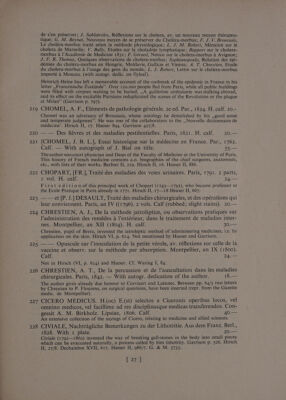
![as le ee 219 220 221 Zee 223 224 225 226 227 de s’en préserver; J. Sablairoles, Réflexions sur le cholera, av. un nouveau moyen thérapeu- tique; G. M. Beynat, Nouveau moyen de se préserver du Choléra-morbus; F. J. V. Broussais, Le choléra-morbus traité selon la méthode physiologique; L. J. M. Robert, Mémoire sur le cholera de Marseille; V. Bally, Etudes sur la choladrée lymphatique; Rapport sur le cholera- morbus a l’Académie de Medicine 1831; F. Gérard, Notice sur le cholera-morbus a Avignon; J. F. R. Thomas, Quelques observations de cholera-morbus; Sophianopoulo, Relation des épi- démies du cholera-morbus en Hongrie, Moldavie, Gallicie et Vienna; A. T. Chrestien, Etude du cholera-morbus a l’usage des gens du monde; L. J. Robert, Lettre sur le cholera-morbus importé a Moscou. (with autogr. dedic. on flyleaf). Heinrich Heine has left a memorable account of the outbreak of the epidemic in France in his letter ,,Franz6sische Zustande’”’. Over 120.000 people fled from Paris, while all public buildings were filled with corpses waiting to be buried. ,,A guillotine ambulante was stalking abroad, and its effect on the excitable Parisians reduplicated the scenes of the Revolution or the plague at Milan’ (Garrison p. 797). CHOMEL, A. F., Eléments de pathologie générale. 2e ed. Par., 1824. H. calf. 20.- Chomel was an adversary of Broussais, whose ontology he demolished by his ,,go0o0d sense and temperate judgment’’. He was one of the collaborators to the ,,Nouvelle dictionnaire de médecine’. Hirsch II, 17. Haeser 894. Garrison 427/8. —-— Des fiévres et des maladies pestilentielles. Paris, 1821. H. calf. 20.— [CHOMEL, J. B. L.], Essai historique sur la médecine en France. Par., 1762. Calf. — With autograph of J. Bial on title. 35.— The author wascourt physician and Dean of the Faculty of Medicine at the University of Paris. This history of French medicine contains a.o. biographies of the chief surgeons, anatomists, etc., with lists of their works. Barbier II, 219. Hirsch II, 16. Heaser II, 886. CHOPART, [FR.], Traité des maladies des voies urinaires. Paris, 1791. 2 parts, Lavolo HH cai, 24.— First edition of this principal work of Chopart (1743—1795), who became professor at the Ecole Pratique in Paris already in 1771. Hirsch II, 17—18 Heaser II, 667. —-— et [P. J.] DESAULT, Traité des maladies chirurgicales, et des opérations qui leur conviennent. Paris, an IV ((1796). 2 vols. Calf (rubbed; slight stains). 20.— CHRESTIEN, A. J., De la méthode jatroliptice, ou observations pratiques sur l’administration des remédes a l’extérieur, dans le traitement de maladies inter- nes. Montpellier, an XII (1804). H. calf. 30.— Chrestien, pupil of Brera, invented the iatroleptic method of ‘administering medicines, i.e. by application on the skin. Hirsch VI, p. 624. Not mentioned by Haeser and Garrison. — -— Opuscule sur l’inoculation de la petite vérole, av. réflexions sur celle de la vaccine et observ. sur la méthode par absorption. Montpellier, an IX (1800). Calf. 24.— Not in Hirsch (VI, p. 624) and Haeser. Cf. Waring I, 84. CHRESTIEN, A. T., De la percussion et de l’auscultation dans les maladies chirurgicales. Paris, 1842. — With autogr. dedication of the author. 18.— The author gives already due honour to Corvisart and Laénnec. Between pp. 64/5 two letters by Chrestien to P. Flourens, on surgical questions, have been inserted (repr. from the Gazette medic. de Montpellier). CICERO MEDICUS. H.(oc) E.(st) selectos e Ciceronis operibus locos, vel omnino medicos, vel facillime ad res disciplinasque medicas transferendos. Con- gessit A. M. Birkholz. Lipsiae, 1806. Calf. AO An extensive collection of the sayings of Cicero, relating to medicine and allied sciences. 1828. With 1 plate. 20.— Civiale (1792—1862) invented the way of breaking gall-stones in the body into small pieces which can be evacuated naturally, a process called by him lithotrity. Garrison p. 526. Hirsch II, 27/8. Dechambre XVII, 617. Haeser II, 986/7. G. & M. 3733. Ea}](https://iiif.wellcomecollection.org/image/b33159397_0043.jp2/full/800%2C/0/default.jpg)
 No text description is available for this image
 No text description is available for this image
 No text description is available for this image