Thirty-third annual report of the directors of James Murray's Royal Asylum for Lunatics, near Perth. June, 1860.
- James Murray's Royal Asylum for Lunatics
- Date:
- 1860
Licence: Public Domain Mark
Credit: Thirty-third annual report of the directors of James Murray's Royal Asylum for Lunatics, near Perth. June, 1860. Source: Wellcome Collection.
31/104 (page 31)
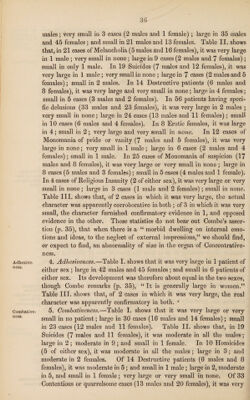
![kind. There are certain other propositions with which we agree; but these, we are bound to confess, are few in number. And lastly, there are certain others, which are so totally opposed to our whole reading and experience—-anatomical and physiological, psychopathic and psycho¬ logical,— that we cannot hesitate to pronounce them erroneous, and frequently worse than erroneous—presumptuous and absurd. Among statements, which our own experience does not bear out or corroborate, are the following :— “ The amount of power possessed by each mental faculty [is] modi¬ fied by, and the result of, the size, structure, and quality of these ence¬ phalic divisions, and its energy indicated by certain easily distinguished convolutions of the brain, discoverable during life by parallel protuber¬ ances on its shield, the skull.”—[Smith, p. 5]. “ The size of the brain, in whatever direction developed, is the mea¬ sure of general mental power. If it be in the direction of the propen¬ sities, the individual will manifest power of animal passion; if in that of the sentiments, the momentum will be of a moral kind; if in the an¬ terior lobe, it will produce superiority of reflection; and if in all regions, it will result in universal greatness.”—[Smith, p. 38]. “ It being established [?] that the size of the brain is the measure of its power, it follows, upon the same principle, that the size of each organ in the encephalon is the measure of its power also.”—[Smith, p. 71]- “ It is a principle of Phrenology, that the largest organ in each head is that which craves for greatest excitement, and receives most gratifica¬ tion.”—[Smith, p. 72]. “ The brain consists of a congeries of organs, the instruments of a corresponding number of mental faculties, each possessing an individual and separate function.”—[Smith, p. 31]. Phrenology is “ based altogether upon the observation of a correspond¬ ence betwixt cerebral projection and mental manifestations, or absence of development and deficiency of relative psychological indications.”— [Smith, p. 5]. It is obviously impossible for us to enter upon any disquisition or argumentative essay to show wherein and how far we differ from phrenologists in such statements as we have above given. It must suffice to point to our Statistical Tables, which, while they indicate many parallelisms or coincidences between phenomena or facts, which coincidence!* phrenologists assert stand in the relation of cause and effect, yet show a dilftionfln' greater number either of contradictions, discrepancies, or non-corrobora-facts- tive circumstances. In a word, the post hoc and the propter hoc seem to us to have been in no small measure confounded. Among statements with which we are disposed to agree, and which](https://iiif.wellcomecollection.org/image/b30302249_0031.jp2/full/800%2C/0/default.jpg)