Thirty-third annual report of the directors of James Murray's Royal Asylum for Lunatics, near Perth. June, 1860.
- James Murray's Royal Asylum for Lunatics
- Date:
- 1860
Licence: Public Domain Mark
Credit: Thirty-third annual report of the directors of James Murray's Royal Asylum for Lunatics, near Perth. June, 1860. Source: Wellcome Collection.
33/104 (page 33)
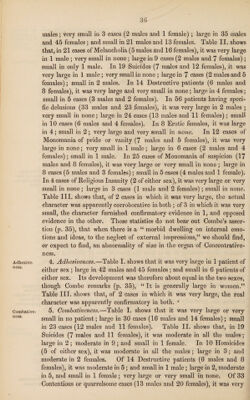
![applicable generally to his remarks on the light which Phrenology throws on the study of Insanity. “We confess that we are inclined to Hypothesis distrust many of Gall’s observations on the subject of the organs in a tionversus state of disease, because they appear to be mere conjectures.”—[p.149]. fact' “ Partial insanity or madness on one point, with sanity on every other, proves the distinction of organs and their separate action.”— . | Chambers, p. 354]. Here is a proof depending upon an assumption; both proof and assumption being, in our opinion, equally erroneous. We demur at once to the whole statement. We are not prepared to admit that there Monomania is such a thing as “ madness on one point with sanity on every other f believing, with Dr Bucknill, that “ insanity on a single subject impli¬ cates many of the faculties.”* This use of the term “ Partial Insanity” leads us further to observe, that all Phrenological classifications of In- Phrenoiogi- sanity founded on such an analysis of the cerebral “ organs ” and tSns oflGca their functions as is given in our Table I., hereto appended, though Insamty- they have looked extremely attractive and satisfactory on paper, have been of no scientific value and of no practical usefulness, because the bases on which they were founded were not altogether and solely true. Various systems of classification have been proposed, as Dr Buck¬ nill points out (p. 86), under a division of the faculties of the mind into, 1, Intellectual, and 2, Affective, with sub-divisions into a, Propensities, and 6, Sentiments; or, under a triple division, into, 1, Intellectual facul¬ ties ; 2, Moral sentiments; and 3, Propensities. But such classifications are unnatural and mischievous, simply because it never happens that any one faculty, or even group of faculties, is singly the seat of disease ; or, in other words, because disease of one faculty, or group of faculties, implies and involves a certain amount of disease of another faculty or group. True it is, nevertheless, that disease may appear predominant, for the time being, in a particular faculty or organ, or set of faculties or organs; but this is only apparent, and not real. For instance, some of the intellectual faculties may appear alone diseased in certain cases of what is wrongly so-called iliemo-mania, where one or a few delusions only exist, or, at all events, are made manifest; or some of the moral sentiments, as in Melancholia, or exultative Insanity connected with the development of religious ideas or belief, pride, ambition, &c.; or some of the propensities, as in Suicidal and Homicidal Insanity, in Kleptomania, Pyromania, Dipsomania, or Erotomania. But, in such cases, we do not find the Intellectual faculties, Sentiments, or Propensities singly and separately involved in disease; but, to a greater or less extent, all of them. And hence it is that Phrenology does not enable us to frame a useful or philosophical classification of mental diseases. Let us now proceed to a general analysis of our Statistical Tables. * “ Manual of Psychological Medicine,” p. 326. London, 1858.](https://iiif.wellcomecollection.org/image/b30302249_0033.jp2/full/800%2C/0/default.jpg)