A practical treatise on fractures and dislocations / by Frank Hastings Hamilton.
- Frank Hastings Hamilton
- Date:
- 1891
Licence: Public Domain Mark
Credit: A practical treatise on fractures and dislocations / by Frank Hastings Hamilton. Source: Wellcome Collection.
Provider: This material has been provided by the Francis A. Countway Library of Medicine, through the Medical Heritage Library. The original may be consulted at the Francis A. Countway Library of Medicine, Harvard Medical School.
40/858 page 46
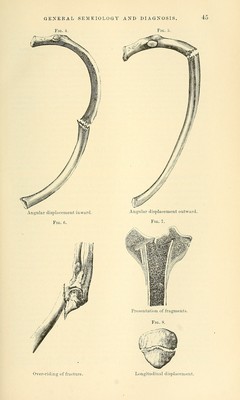
![3. Rotatory displacement is a change in the long axis of the fragments, as in fractures of the femur, when the foot falls outward and changes the axis of the lower fragment in its relation to the upper fragment. -i. Overriding is the most frequent displacement, and is due to the passage of one fragment over the others. It is found in oblique fractures of the shaft of long bones (Fig. 6). 5. Penetration of the fragment, impaction, may occur in long or short bones. In the long bones the shaft usually penetrates the cancellated extremity (Fig. 7); in the short bones the injury is of a crushing nature, and the fragments are driven into the cancellated tissue. 6. Longitudinal displacement is found in fractures of the patella, and occa- sionally in the shaft of long bones (Fig. 8). In addition to these forms of displacement, there are combinations caused by the violence which produced the fracture, or by the action of the muscles subse- quent to the fracture. Too careful attention cannot be given to these changed positions when the limb is first examined.] CHAPTER IV. REPAIR OF BROKEN BONES. The reparative material, consisting originally of a plastic lymph, is poured out from the vessels of the Haversian canals, the medullary tissue, the periosteum, and more or less from all of the lacerated tissues which are immediately adjacent to the seat of fracture; but probably in greatest abundance from the periosteum. After a period, longer or shorter, this lymph becomes organized, and begins to receive from the same sources particles of bony matter, through which the consolidation is finally effected. The transition from the original plastic material to bone is in adults almost constantly through the interposition of connective tissue, rarely, unless in the case of children, through a cartilaginous tissue, and sometimes through both consentaneously or consecutively. In a few fortunate examples bones unite directly or immediately, without the intervention of a reparative material. Finally, granulation-tissue some- times becomes transformed into bone, in certain cases of compound fractures, or of fractures in which the process of inflammation exceeds certain limits. Dupuytren, enlarging upon the doctrines taught by Galen, Duhamel, Camper, and Haller, declared that nature never accomplishes the immediate union of a fracture save by the formation of two successive deposits of callus; one of which is derived from the periosteum, the adjacent tissues, and from the medulla ; while the other, derived, perhaps, from the broken extremities of the bone itself, is found at a later period directly interposed between these surfaces. The material or callus derived from the tissues outside of the bone, and which Galen compared to a ferrule, but which Mr. Paget calls ensheathing, together with the material derived from the medulla, compared often to a plug, and by Mr. Paget named interior callus, is by Dupuytren spoken of as the provisional or temporary callus, by which the fragments are supported, and maintained in contact until the permanent callus is formed. This temporary splint is com- pleted or has arrived at the condition of bone in a spongy form, at periods varying from twenty to sixty days; but it does not assume the character of](https://iiif.wellcomecollection.org/image/b21056699_0040.jp2/full/800%2C/0/default.jpg)