The human spine : an analysis of the comparative merits of the gypsum jacket and compound adjustable supports.
- Banning, E. P. (Edmund Prior), 1810-
- Date:
- 1881
Licence: Public Domain Mark
Credit: The human spine : an analysis of the comparative merits of the gypsum jacket and compound adjustable supports. Source: Wellcome Collection.
Provider: This material has been provided by the Augustus C. Long Health Sciences Library at Columbia University and Columbia University Libraries/Information Services, through the Medical Heritage Library. The original may be consulted at the the Augustus C. Long Health Sciences Library at Columbia University and Columbia University.
19/42 page 13
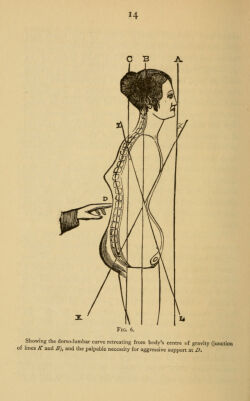
![neous and conjoint lifting action of the lower part upon the abdomen, of the crutches under the axilla, and the bracing forward and drawing back action of the revolving plates and the shoulder-caps, all the truncal muscles (and bones as well) are supplemented ; that the whole trunk, without and within, is lengthened and expanded; that the face of the spine is being steadily lengthened, and its dorsum shortened, and that the dissolving bones and cartilages are relieved of a disorganizing pressure; that the pelvic organs and the circulations of the extremities are relieved from any depressing force; the viscera, also, are re- stored i]i situ to freedom, and the stomach, liver, and spleen to the warming and stimulating support of the bowels ; that the inverted diaphragm is again con- cavo-convexed ; that the heart is properly supported, and the freest play given to all the organs of respira- tion. Furthermore, a mere superficial glance will sug- gest that there is not one backward, inward, contract- ing, or depressing action, nor the compression of one vessel, viscus, or muscle; but that, on the contrary, the spine and abdomen are shoved outward and for- ward^ just as in the action of the abdomen, spine, and scapula, when a man thinks enough of himself to bring those muscles into requisition in health. In- deed, it seems to act so in accord and concord with the idea of the Maker in setting up and running the body, that it only rests the discouraged parts, and so helps them as to encourage and inspire them to re- sume their own work ; hence it is, that unlike too many artificial supports which act by mere force, out-](https://iiif.wellcomecollection.org/image/b21229314_0019.jp2/full/800%2C/0/default.jpg)

 No text description is available for this image
 No text description is available for this image
 No text description is available for this image