Licence: In copyright
Credit: Classification and uses of finger prints. Source: Wellcome Collection.
Provider: This material has been provided by The University of Glasgow Library. The original may be consulted at The University of Glasgow Library.
117/164 page 107
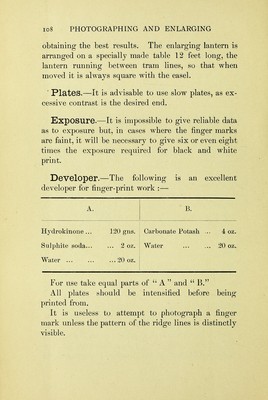
![be sprinkled over with a little gray powder and this subsequently lightly brushed off with a camel- hair brush. Should however the wood be white in colour, graphite may be used instead of the gray powder. The ex]Deriment may be made of impressing the fingers on a piece of smooth dark wood, glass, or metal, afterw\ards sprinkling a Httle gray powder over the place touched by the fingers, and brushing oiF carefully with a camel-hair brush. To photograph the marks that will show themselves, proceed as for plated goods. At times burglars leave behind them pieces of candle which they have handled, and on which there are good imprints of some of their fingers. In these instances the ridges of the fingers create furrows in the candle and should be treated as follows :—Smear a small drop of printers' black ink over the mark, and wipe off carefully with tufts of cotton wool until the ink is cleared away with the exception of that in the furrows, then photograph as for printed matter. When finger prints are required for production in Courts of Justice, they are first enlarged 5 diameters direct with an enlarging camera. The negatives are afterwards placed in an electric light enlarging lantern, with which it is possible to obtain a photo- graphic enlargement of a finger-print 36 inches square, such a photograph being as large as is ever likely to be required. A specially built dark enlarging room 21 feet long by 7 feet wide has recently been fitted up at New Scotland Yard with all the necessary requirements for](https://iiif.wellcomecollection.org/image/b21463402_0117.jp2/full/800%2C/0/default.jpg)