The history of Clerkenwell / by William J. Pinks ; with additions by the editor, Edward J. Wood.
- Pinks, William J. (William John), 1829-1860
- Date:
- 1881
Licence: Public Domain Mark
Credit: The history of Clerkenwell / by William J. Pinks ; with additions by the editor, Edward J. Wood. Source: Wellcome Collection.
87/886 (page 53)
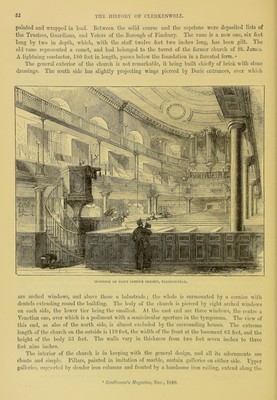
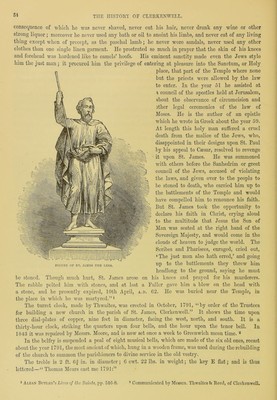
![cides of the building at a considerable height; and although erected subsequently to the bulling of the church, viz., in 1822, arc no disfigurement to the interior of it. They are intended for ic accommodation of the children of the Sunday Schools. The galleries for the charity clnldien are in recesses at the west end, which is semicircular. ,, The lar-e Venetian window at the cast end is blank, and divided by two pilasters into three compartments, in the centre one of which is painted the Hebrew word “Jehovah,” encircled by a glory and above is the representation of a curtain. In the semicircular space at the top are figures ot angels and a descending dove. In the side compartments arc sacred emblems; on either side formerly hung the colours of the old Clcrkcnwell Volunteers. _ „ _ . , n ,, The altar-piece is composed of pillars, an entablature and pediment of the Doric order. On the apex of the pediment are the royal arms, carved, painted, and gilt; on the tympanum is a celcstia crown and palm branches, beneath, on four panels, are inscribed the Creed, the Lord s liajei, and the Decalogue. Upon the wall on either side are bass reliefs representing the communion vessels and a censer containing incense suspended by ribbons. At either extremity of the entablature is placed a SlltThe pews arc grained in imitation of oak, and capped with mahogany. The pulpit and reading dCSlTto tetd^umber of sittings in the church is about 1500, of which about 800 are free seats. The organ, a beautiful instrument, was made by George Tike England, in 1/90, and cost oOU The old organ was subsequently disposed of by England for £220, and erected in the parish church of Bccclcs, Suffolk.1 The present instrument has two rows and a half of keys, and contains twenty-one stops, but has no pedal pipes. . . , , , The font was erected on Christmas-cve, 1851. It is of Portland stone, of circular form, and stanc s at the west end of the nave upon an octagonal step. The bowl is cylindrical, and is ornamented with twelve architectural olive leaves, with palm leaves in the interstices, supported on a plain circular shaft with a boldly moulded spreading base. It is in the lloman style (the same as t ic c mrc i,, but the proportions partake of the medieval fonts which are introduced as an improvement upon the slender baluster font in London churches. The font is lined with lead, and has a water drain. It was designed by its promoter, AV. P. Griffith, Esq., who raised the money for its erection ]fy a half-crown subscription. It cost £11 17s. Gd. On the cover, which is of plain oak, and harmonious in design, is the following inscription on a circular brass plate “This font presented by public subscription, was erected Xmas-cve, 1851, and designed by W. P. Griffith, architect. The lid was the gift of Mr. David Fowler of this parish. D. Titmuss and C. Hill, churchwardens.’ The old font, of white marble, placed in 1788, was a small one, being not large enough for the total immersion of an infant if required by its sponsors. It has been broken up. Before the present font was placed a common leaden bowl was used at christenings. The vestry is a very commodious apartment, and was formerly much used for 'Ne^tiy meetings and other parochial purposes, and some years ago baptisms were administered there. It contains several thins of interest. Over the fireplace is a neatly executed model of the steeple of the church ; opposite, rolled up, and enclosed in a mahogany case, is a Plan of Clcrkcnwell, drawn for various parochial purposes in the year 1808 by John Tyrcr, and upon the case containing this plan is placed a small painted carved wood figure of the apostle St. James the Less, to whom the parish church is dedicated. St. James the Less was so called to distinguish him from the other apostle, the son of Zebcdcc, which appellation is supposed to have been given either from his being called later to the apostleship than the former, or from the smallness of his stature. He is also known as St. James the Just, lie was the son of Alplicas and Mary, the sister of the Virgin Mary. James and his brother Jude were called to the apostleship in the second year of our Lord’s ministry. After his resurrection Christ appeared to James (1 Cor. xv. 7). He was afterwards made Bishop of Jerusalem, and ordered the affairs of the Christian Church in that city, “lie was always a virgin and was a Nazarite, in 1 IIorKiN’s History of the Organ, p. 108.](https://iiif.wellcomecollection.org/image/b24863944_0087.jp2/full/800%2C/0/default.jpg)