Climate, considered especially in relation to man / by Robert DeCourcy Ward.
- Robert DeCourcy Ward
- Date:
- [1908], [©1908]
Licence: Public Domain Mark
Credit: Climate, considered especially in relation to man / by Robert DeCourcy Ward. Source: Wellcome Collection.
Provider: This material has been provided by the Augustus C. Long Health Sciences Library at Columbia University and Columbia University Libraries/Information Services, through the Medical Heritage Library. The original may be consulted at the the Augustus C. Long Health Sciences Library at Columbia University and Columbia University.
378/408 (page 354)
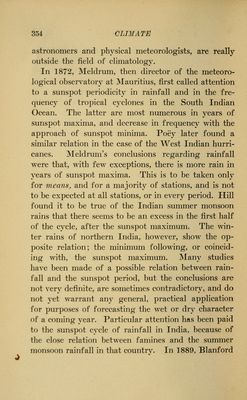
![astronomers and physical meteorologists, are really outside the field of climatology. In 1872, ]Meldrmn, then director of the meteoro- logical observatory at ]Mauritius, first called attention to a sunspot periodicity in rainfall and in the fre- quency of tropical cyclones in the South Indian Ocean. The latter are most numerous in years of sunspot maxima, and decrease in frequency with the approach of sunspot minima. Poey later found a similar relation in the case of the West Indian hurri- canes. ]Meldrum's conclusions regarding rainfall T^ere that, with few exceptions, there is more rain in years of sunspot maxima. This is to be taken only for means, and for a majority of stations, and is not to be expected at all stations, or in every period. Hill found it to be true of the Indian summer monsoon rains that there seems to be an excess in the first half of the cycle, after the sunspot maximum. The win- ter rains of northern India, however, show the op- posite relation; the minimum following, or coincid- ing with, the sunspot maximum. JNIany studies have been made of a possible relation between rain- fall and the sunspot period, but the conclusions are not very definite, are sometimes contradictory, and do not yet warrant any general, practical application for purposes of forecasting the wet or dry character of a coming year. Particular attention has been paid to the sunspot cycle of rainfall in India, because of the close relation between famines and the summer monsoon rainfall in that country. In 1889, Blanford](https://iiif.wellcomecollection.org/image/b2120469x_0378.jp2/full/800%2C/0/default.jpg)