Climate, considered especially in relation to man / by Robert DeCourcy Ward.
- Robert DeCourcy Ward
- Date:
- [1908], [©1908]
Licence: Public Domain Mark
Credit: Climate, considered especially in relation to man / by Robert DeCourcy Ward. Source: Wellcome Collection.
Provider: This material has been provided by the Augustus C. Long Health Sciences Library at Columbia University and Columbia University Libraries/Information Services, through the Medical Heritage Library. The original may be consulted at the the Augustus C. Long Health Sciences Library at Columbia University and Columbia University.
86/408 (page 62)
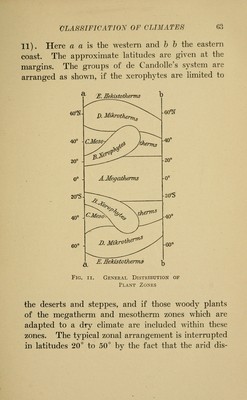
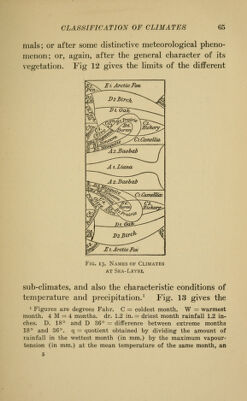
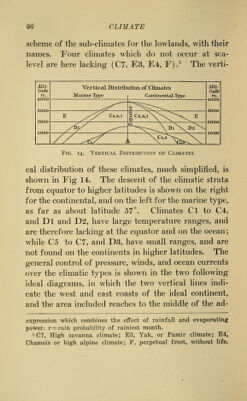
![high summer temperatures; others shun low whi- ter temperatures; others shun the dryness which of- ten accompanies high summer temperatures. These plants inhabit latitudes between 22° and 45° N. or 40° S., so long as the moisture continues sufficient. There is a cool season—coldest month below 64.5° (18° C.)—and a hot summer—warmest month over 72° (22° C),—or a mild winter—coldest month over 43° (6° C.)^—or both. The classic JNIediterranean climate is found in this belt. The mesotherm belt contains the tea, mate, rice, cotton, magnolia, hickory, arbor vitae, hemlock, wheat, corn, olive, fig, grape, heath, cinchona, etc. D. Mikrotherms: need less heat, lower mean an- nual temperature, cooler and shorter summers, and colder winters. The warmest month is at least 50° (10° C.) and not over 72° (22° C.) ; the coldest is be- low 43° {6°. C), with at least an occasional snow- cover in winter and sufficient rainfall in the warmei' season. Evergreen and deciduous forests, grains, and, in the warmer portions, fruit and corn are found. E. Hekistotlierins: plants of the Arctic zone, be- yond the limits of tree growth and of the zone of scrubby Antarctic vegetation. These need the least heat. ]\Iosses, lichens, and similar lowly forms are typical. A simple scheme of distribution of these five groups of plants may first be developed with reference to an ideal continent, stretching from pole to pole, with oceans on both sides and without mountains (Fig.](https://iiif.wellcomecollection.org/image/b2120469x_0086.jp2/full/800%2C/0/default.jpg)