On the crustacea collected during the 'Skeat expedition' to the Malay peninsula. Pt. II. Anomura, Cirripedia, and Isopoda / by W.F. Lanchester.
- Lanchester, William Foster.
- Date:
- 1902
Licence: In copyright
Credit: On the crustacea collected during the 'Skeat expedition' to the Malay peninsula. Pt. II. Anomura, Cirripedia, and Isopoda / by W.F. Lanchester. Source: Wellcome Collection.
Provider: This material has been provided by The Royal College of Surgeons of England. The original may be consulted at The Royal College of Surgeons of England.
13/26 page 373
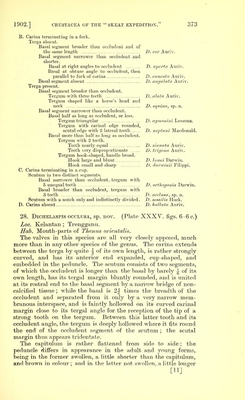
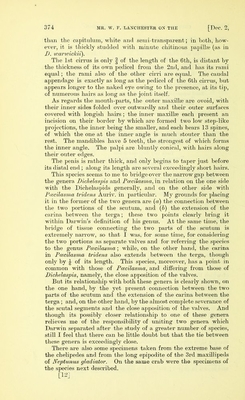
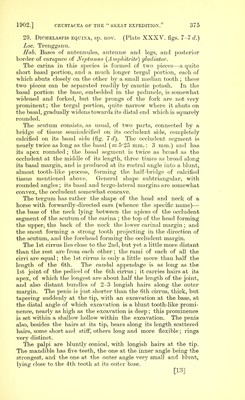
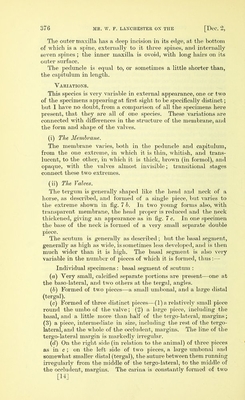
![B. Carina terminating in a fork. Terga absent. Basal segment broader than occludent and of the same length D. cor Auriv. Basal segment narrower than occludent and shorter. Basal at right angles to occludent D. ayperta Auriv. Basal at obtuse angle to occludent, then parallel to fork of carina D. cuneata Auriv. Basal segment absent D. angulata Auriv. Terga present. Basal segment broader than occludent. Tergum with three teeth D. alata Auriv. Tergum shaped like a horse’s head and neck D. equina, sp. n. Basal segment narrower than occludent. Basal half as long as occludent, or less. Tergum triangular D. aymonini Lessona. Tergum with carinal edge rounded, scutal edge with 2 lateral teeth D. nejptuni Macdonald. Basal more than half as long as occludent. Tergum with 2 teeth. Teeth nearly equal D. sinuata Auriv. Teeth very disproportionate D. trigona Auriv. Tergum hook-shaped, handle broad. Hook large and blunt D. lotoei Darwin. Hook small and sharp I), danoinii Filippi. C. Carina terminating in a cup. Scutum in two distinct segments. Basal narrower than occludent, tergum with 5 unequal teeth D. orbhogonia Darwin. Basal broader than occludent, tergum with 3 teeth D. occlusa, sp. n. Scutum with a notch only and indistinctly divided. D. sessilis Hoek. D. Carina absent D. bullata Auriv. 28. Dichelaspis occlusa, sp. nov. (Plate XXXY. figs. 6-6 c.) Loc. Kelantan ; Trengganu. Hob. Mouth-parts of Thenus orientalis. The valves in this species are all very closely apposed, much more than in any other species of the genus. The carina extends between the terga by quite ^ of its own length, is rather strongly curved, and has its anterior end expanded, cup-shaped, and embedded in the peduncle. The scutum consists of two segments, of which the occludent is longer than the' basal by barely ^ of its own length, has its tergal margin bluntly rounded, and is united at its rostral end to the basal segment by a narrow bridge of non- calcified tissue; while the basal is 2| times the breadth of the occludent and separated from it only by a very narrow mem- branous interspace, and is faintly hollowed on its curved carinal margin close to its tergal angle for the reception of the tip of a strong tooth on the tergum. Between this latter tooth and its occludent angle, the tergum is deeply hollowed where it fits round the end of the occludent segment of the scutum ; the scutal margin thus appears tridentate. The capitulum is rather flattened from side to side; the peduncle differs in appearance in the adult and young forms, being in the former swollen, a little shorter than the capitulum, and brown in colour; and in the latter not swollen, a little longer [ii]](https://iiif.wellcomecollection.org/image/b22406554_0015.jp2/full/800%2C/0/default.jpg)