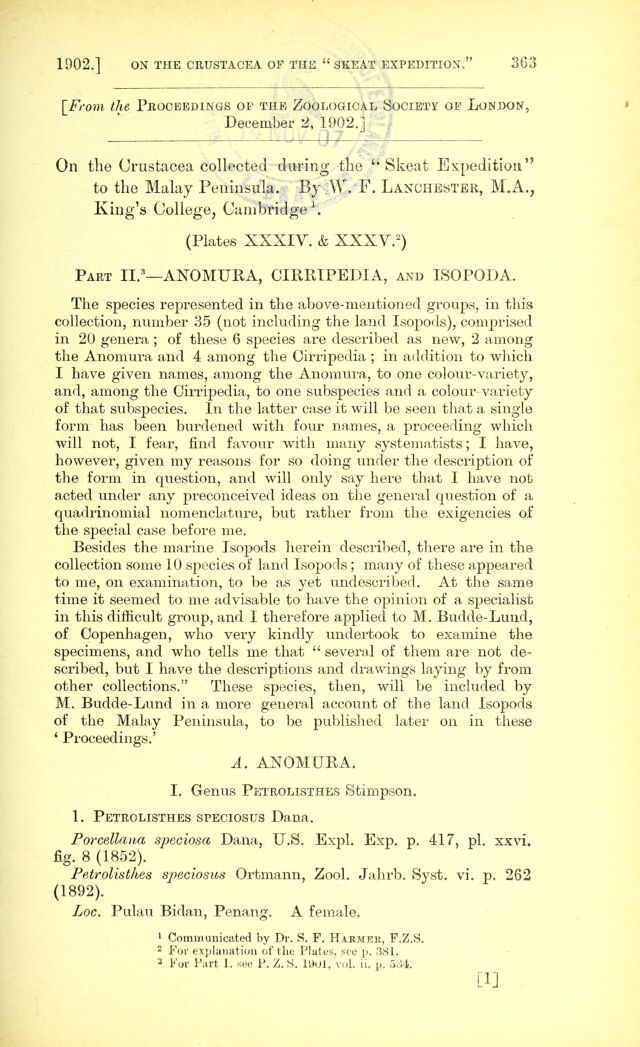
On the crustacea collected during the 'Skeat expedition' to the Malay peninsula. Pt. II. Anomura, Cirripedia, and Isopoda / by W.F. Lanchester.
- Lanchester, William Foster.
- Date:
- 1902
Licence: In copyright
Credit: On the crustacea collected during the 'Skeat expedition' to the Malay peninsula. Pt. II. Anomura, Cirripedia, and Isopoda / by W.F. Lanchester. Source: Wellcome Collection.
Provider: This material has been provided by The Royal College of Surgeons of England. The original may be consulted at The Royal College of Surgeons of England.
8/26 page 368
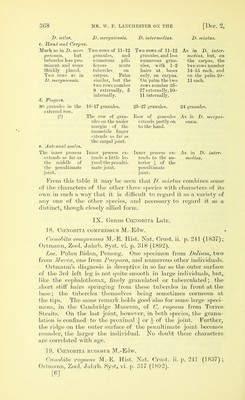
![D. miles. c. Sand and Carpus. Much as in D. mer- guiensis, but tubercles less pro- minent and more thickly placed. Two rows as in I), merguiensis. d. Fingers. 80 granules in the external row. (?) e. Antennal scales. The inner process extends as far as the middle of the penultimate joint. I). merguiensis. Two rows of 11-12 granules, and numerous pili- ferous acute tubercles on carpus. Palm similar, but the two rows number 8 externally, 5 internally. 16-17 granules. The row of gran- ules on the under margin of the immobile finger extends as far as the carpal joint. Inner process ex- tends a little be- yond the penulti- mate joint. S. intermedins. Two rows of 11-12 granules, and less numerous gran- ules, with 1-2 hairs at bases only, on carpus. On palm the two rows number 25- 27 externally, 10- 11 internally. 25-27 granules. Row' of granules extends partly on to the hand. Inner process er- tends to the an- terior 5 of the penultimate joint. F. mixtus. As in D. inter- medins, but, on the carpus, the two rows number 14-15 each, and on the palm 10- 11 each. 24 granules. As in D. mergui- ensis. As in D. inter- medins. From this table it may be seen that D. mixtus combines some of the characters of the other three species with characters of its own in such a way that it is difficult to regard it as a variety of any one of the other species, and necessary to regard it as a distinct, though closely allied form. IX. Genus Ccenobita Latr. 18. Ccenobita compressus M.-Edw. Coenobita compressus M.-E. Hist. Nat. Crust, ii. p. 241 (1837); Ortmann, Zool. Jahrb. Syst. vi. p. 318 (1892). Loc. Pulau Biclan, Penang. One specimen from Dolium, two from Mur ex, one from Purpura, and numerous other individuals. Ortmann’s diagnosis is deceptive in so far as the outer surface of the 3rd left leg is not quite smooth in large individuals, but, like the cephalothorax, finely granulated or tuberculated; the short stiff hairs springing from these tubercles in front at the base; the tubercles themselves being sometimes corneous at the tips. The same remark holds good also for some large speci- mens, in the Cambridge Museum, of C. rugosus from Torres Straits. On the last joint, however, in both species, the granu- lation is confined to the proximal | or 4- of the joint. Further, the ridge on the outer surface of the penultimate joint becomes rounder, the larger the individual. No doubt these characters are correlated with age. 19. Ccenobita rugosus M.-Edw. Coenobita rugosus M.-E. Hist. Nat. Crust, ii. p. 241 (1837); Ortmann, Zool. Jahrb. Syst, vi. p. 317 (1892). [6]](https://iiif.wellcomecollection.org/image/b22406554_0010.jp2/full/800%2C/0/default.jpg)