Clinical methods : a guide to the practical study of medicine / by Robert Hutchison and Harry Rainy.
- Rainy Harry.
- Date:
- 1905
Licence: In copyright
Credit: Clinical methods : a guide to the practical study of medicine / by Robert Hutchison and Harry Rainy. Source: Wellcome Collection.
Provider: This material has been provided by the Royal College of Physicians of Edinburgh. The original may be consulted at the Royal College of Physicians of Edinburgh.
61/682 (page 43)
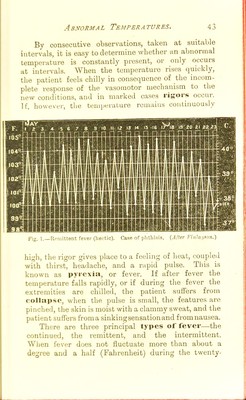
![By consecutive observations, taken at suitable intervals, it is easy to determine whether an abnormal temperature is constantly present, or only occurs at intervals. When the temperature rises quickly, the patient feels chilly in consequence of the incom- plete response of the vasomotor mechanism to the new conditions, and in marked cases rigors occur. If, however, the temperature remains continuously F. ]l'/2Y 3 4-5 6 7 8 9 10 II, 12 13 14 15 -16 lVl8 19 20 $;l$j>g FK i._Remittent fever (lieutic). Case of phthisis. {After Finlayson.) high, the rigor gives place to a feeling of heat, coupled with thirst, headache, and a rapid pulse. Tins is known as pyrexia, or fever. If after fever the temperature falls rapidly, or if during the fever the extremities are chilled, the patient suffers from collapse, when the pulse is small, the features are pinched, the skin is moist with a clammy sweat, and the patient suffers froma sinkingsensationand fromnausea. There are three principal types of fever—the continued, the remittent, and the intermittent. When fever does not fluctuate more than about a degree and a half (Fahrenheit) during the twenty-](https://iiif.wellcomecollection.org/image/b21700023_0063.jp2/full/800%2C/0/default.jpg)