Principles of comparative physiology / by William B. Carpenter.
- William Benjamin Carpenter
- Date:
- 1854
Licence: Public Domain Mark
Credit: Principles of comparative physiology / by William B. Carpenter. Source: Wellcome Collection.
Provider: This material has been provided by Royal College of Physicians, London. The original may be consulted at Royal College of Physicians, London.
80/810 (page 46)
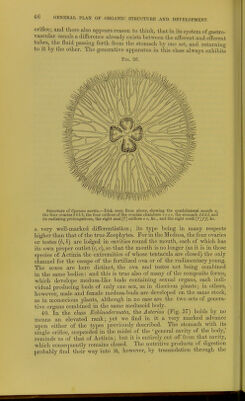
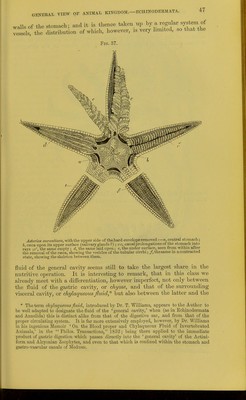
![orifice; and there also appears reason to think, that in its system of gastro- vascular canals a difference already exists between the afferent and efferent tubes, the fluid passing forth from the stomach by one set, and returning to it by the other. The generative apparatus in this class always exhibits Fio. 36. structure of CyaruBa av/rita.—Disk seen from above, shomng the quadrilateral mouth a, the four ovaries bhhh, the four orifices of the ovarian chambers cc ec, the stomach dddd, and its radiating prolongations, the eight anal [?] orifices e e, See., and the eight ooeUi [?]//, &e. a very well-marked differentiation; its type being in many respects higher than that of the true Zoophytes. For in the Medusa, the four ovaries or testes {b, b) are lodged in cavities round the mouth, each of which has its own proper outlet (c, c), so that the mouth is no longer (as it is in those species of Actinia the extremities of whose tentacula are closed) the only channel for the escape of the fertilized ova or of the rudimentaiy young. The sexes are here distinct, the ova and testes not being combined in the same bodies: and this is true also of many of the composite forms, which develope medusa-like buds containing sexual organs, each indi- vidual producing buds of only one sex, as in dioecious plants; in others, however, male and female medusa-buds are developed on the same stock, as in monoecious plants, although in no case are the two sets of genera- tive organs combined in the same medusoid body. 40. In the class Echhiodermata, the Asterias (Fig. 37) holds by no means an elevated rank; yet we find in it a very marked advance upon either of the types previously described. The stomach with its single orifice, suspended in the midst of the ' general cavity of the body,' reminds us of that of Actinia; but it is entirely cut off from that cavity, which consequently remains closed. The nutritive products of digestion probably find their way into it, however, by transudation through the](https://iiif.wellcomecollection.org/image/b24756982_0080.jp2/full/800%2C/0/default.jpg)