Principles of comparative physiology / by William B. Carpenter.
- William Benjamin Carpenter
- Date:
- 1854
Licence: Public Domain Mark
Credit: Principles of comparative physiology / by William B. Carpenter. Source: Wellcome Collection.
Provider: This material has been provided by Royal College of Physicians, London. The original may be consulted at Royal College of Physicians, London.
88/810 (page 54)
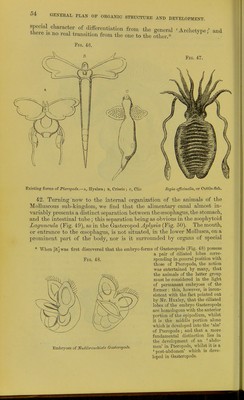
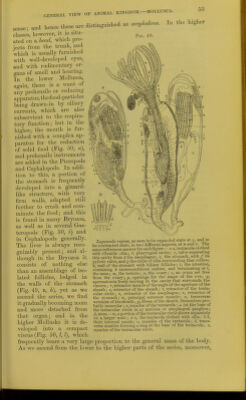
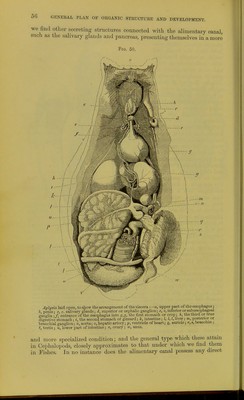
![£i.^n''''w ^-om the general 'Archetype;' and tJieie IS no real transition from the one to the other.* Fio. 47. Existing forms of Pferopode.—A, Hyalaea; b, Criseis ; o, Clio Sepia officinalis, or Cuttle-fish. 42. Turning now to the internal organization of the animals of the Molluscous sub-kingdom, we find that the alimentary canal almost in- variably presents a distinct separation between the oesophagus, the stomach, and the intestinal tube; this separation being as obvious in the zoophytoid Laguncula (Fig. 49), as in the Gasteropod Aplysia (Fig. 50). The mouth, or entrance to the oesophagus, is not situated, in the lower MoUusca, on a prominent part of the body, nor is it surrounded by organs of special * Wlien [it] was first discovered that the embryo-forms of Gasteropods (Fig. 48) possess a pair of ciliated lobes corre- FiG. 48. spending in general position with those of Pteropods, the notion was entertained by many, that the animals of the latter group must be considered in the light of permanent embryoes of the former: this, however, is incon- sistent with the fact pointed out by Mr. Huxley, that the ciliated lobes of the embryo Gasteropoda are homologous with the anterior portion of the epipodium, whilst it is the middle portion alone which is developed into the 'ate' of Pteropods ; and that a more fundamental distinction lies in the development of an ' abdo- men' in Pteropods, whilst it is a 'post-abdomen' which is deve- loped in Gasteropods. Embryoes of Nadilranchiate Gasteropods](https://iiif.wellcomecollection.org/image/b24756982_0088.jp2/full/800%2C/0/default.jpg)