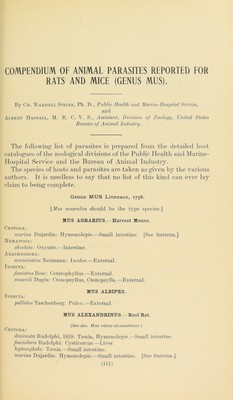
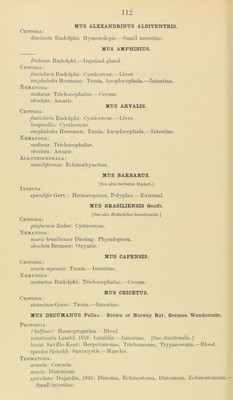
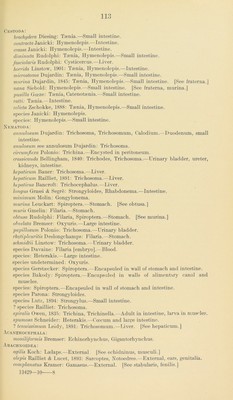
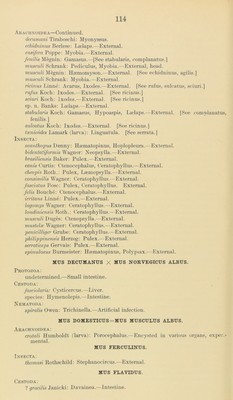
The rat and its relation to the public health / by various authors ; prepared by direction of the Surgeon-General ; Treasury Department, Public Health and Marine Hospital Service of the United States.
- Date:
- 1910
Licence: In copyright
Credit: The rat and its relation to the public health / by various authors ; prepared by direction of the Surgeon-General ; Treasury Department, Public Health and Marine Hospital Service of the United States. Source: Wellcome Collection.
105/286 (page 95)
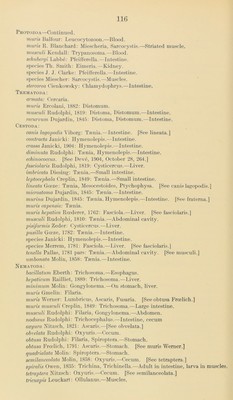
![CESTODA—TAPEWORMS. Of the five cestodes mentioned as coining into consideration in the subject under discussion, only one (Hymenolepis diminuta) need be considered seriously. CYSTICERCUS CELLULOSE—TiENIA SOLIUM. [Fig. 20.] The larval cestode known as Cysticercus cellulosx (which causes “measles” in swine) develops (when eaten In’- man) into a tapeworm which is known as Tsenia solium. This larva is also reported as encysted in the peritoneum of Mus rattus. Even if it be granted that the specific determination of the specimen in question as Cysticercus cellulossc is correct, the occasional infection of rats with this parasite would be of very little practical significance Fig. 21.—Portion ol mesentery of rabbit infected with Cysticercus pisiformis. Natural size. (After Railliet, 1893a, 216, fig. 114.) in this country from a public health point of view, as we do not use rats for food for man. Theoretically it is possible to conceive of combinations of circumstances in which such infection in the rat might under certain conditions eventually affect man, but the chances are so remote as to be negligible, especially when compared with the much greater questions which demand attention. CYSTICERCUS PISIFORMIS—TJENIA PISIFORMIS. [Fig. 21.] The larval stage of this parasite occurs in rabbits, the adult stage in canines. Parona (1901) reports the occurrence of the larval stage- in Mus brasiliensis, and Vital has recorded the presence of the adult stage in man. In view of the fact that Galli-Valerio was unable to infect himself experimentally with this species, the specific determination made by \ ital is open to some question. Even assuming that this tapeworm may develop in man, the presence of the larval stage in rats is of such little importance as to be negligible.](https://iiif.wellcomecollection.org/image/b28050733_0105.jp2/full/800%2C/0/default.jpg)