The rat and its relation to the public health / by various authors ; prepared by direction of the Surgeon-General ; Treasury Department, Public Health and Marine Hospital Service of the United States.
- Date:
- 1910
Licence: In copyright
Credit: The rat and its relation to the public health / by various authors ; prepared by direction of the Surgeon-General ; Treasury Department, Public Health and Marine Hospital Service of the United States. Source: Wellcome Collection.
111/286 (page 101)
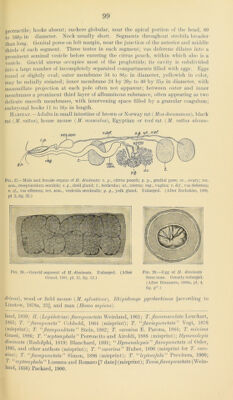
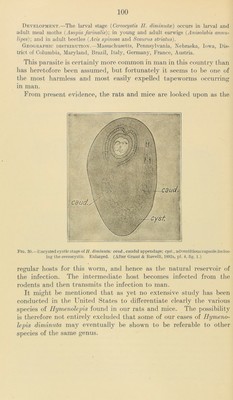
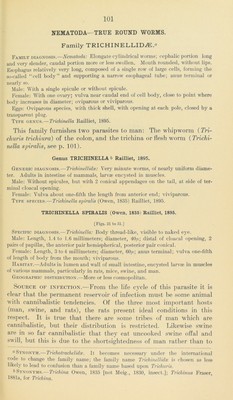
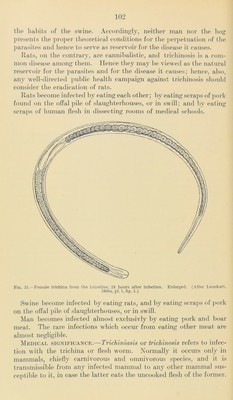
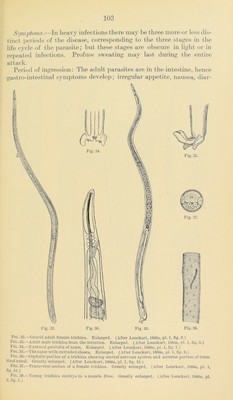
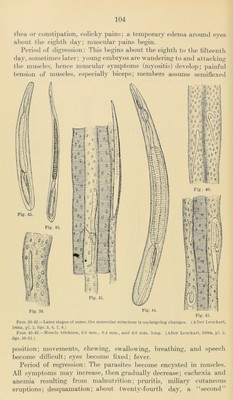
![NEMATODA—TRUE ROUND WORMS. Family TRICHINELLID^E.« Family diagnosis.—Nematoda: Elongate cylindrical worms; cephalic portion long and very slender, caudal portion more or less swollen. Mouth rounded, without lips. Esophagus relatively very long, composed of a single row of large cells, forming the so-called “cell body” and supporting a narrow esophageal tube; anus terminal or nearly so. Male: With a single spicule or without spicule. Female: With one ovary; vulva near caudal end of cell body, close to point where body increases in diameter; oviparous or viviparous. Eggs: Oviparous species, with thick shell, with opening at each pole, closed by a transparent plug. Type genus.— Trichinella Railliet, 1895. This family furnishes two parasites to man: The whipworm (Tri- churls trichiura) of the colon, and the trichina or flesh worm (Trichi- nella spiralis, see p. 101). Genus TRICHINELLA b Railliet, 1895. Generic diagnosis.—Trichinellidx: Very minute worms, of nearly uniform diame- ter. Adults in intestine of mammals, larvae encysted in muscles. Male: Without spicules, but with 2 conical appendages on the tail, at side of ter- minal cloacal opening. Female: Vulva about one-fifth the length from anterior end; viviparous. Type species.—Trichinella spiralis (Owen, 1835) Railliet, 1895. TRICHINELLA SPIRALIS (Owen, 1835) Railliet, 1895. [Figs. 31 to 51.] Specific diagnosis.— Trichinella: Body thread-like, visible to naked eye. Male: Length, 1.4 to 1.6 millimeters; diameter, 40/*; distal of cloacal opening, 2 pairs of papillae, the anterior pair hemispherical, posterior pair conical. Female: Length, 3 to 4 millimeters; diameter, 60/*; anus terminal; Auilva one-fifth of length of body from the mouth; viviparous. Habitat.—Adults in lumen and wall of small intestine, encysted larvae in muscles of various mammals, particularly in rats, mice, swine, and man. Geographic distribution.—More or less cosmopolitan. Source of infection.—From the life cycle of this parasite it is clear that the permanent reservoir of infection must be some animal with cannibalistic tendencies. Of the three most important hosts (man, swine, and rats), the rats present ideal conditions in this respect. It is true that there are some tribes of man which are cannibalistic, but their distribution is restricted. Likewise swine are in so far cannibalistic that they eat uncooked swine offal and swill, but this is due to the shortsightedness of man rather than to ° Synonym.—Trichotrachelidx. It becomes necessary under the international code to change the family name; the family name Trichinellidx is chosen as less likely to lead to confusion than a family name based upon Trichuris. k Synonyms.—Trichina Owen, 1835 [not Meig., 1830, insect.]; Tricliinus Fraser, 1881a, for Trichina.](https://iiif.wellcomecollection.org/image/b28050733_0111.jp2/full/800%2C/0/default.jpg)