The elements of natural philosophy, or, An introduction to the study of the physical sciences / by Golding Bird and Charles Brooke.
- Golding Bird
- Date:
- 1860
Licence: Public Domain Mark
Credit: The elements of natural philosophy, or, An introduction to the study of the physical sciences / by Golding Bird and Charles Brooke. Source: Wellcome Collection.
Provider: This material has been provided by Royal College of Physicians, London. The original may be consulted at Royal College of Physicians, London.
699/736
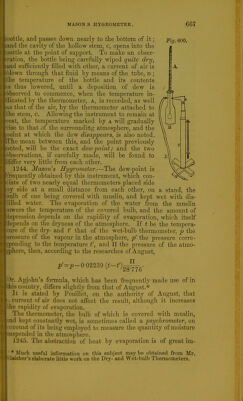
![Fig. 600. ottle, and passes down nearly to the bottom of it; mdthe cavity of the hollow stem, c, opens into the ttle at the point of support. To make an obser- ition, the bottle being carefully wiped quite dry, aid sufSciently filled with ether, a current of air is 'lown through that fluid by means of the tube, d ; he temperature of the bottle and its contents - thus lowered, until a deposition of dew is served to commence, when the temperature in- ated by the thermometer, A, is recorded, as well that of the air, by the thermometer attached to ' stem, c. Allowing the instrument to remain at st, the temperature marked by a will gi-adually -c to that of the surrounding atmosphere, and the iut at which the dew disappears, is also noted, i he mean between this, and the point previously loted, will be the exact dew-point; and the two l)SHrvations, if carefully made, will be found to h'ffer very little from each other. 1244. Mason-s Hygrometer.—The dew-point is quently obtained by this instrument, which cen- ts of two nearly equal thermometers placed side •y side at a small distance from each other, on a stand, the lib of one being covered with muslin, and kept wet with dis- illed water. The evaporation of the water from the muslin ' iwera the temperature of the covered bulb, and the amount of ])ression depends on the rapidity of evaporation, which itself pends on the dryness of the atmosphere. If t be the tempera- uro of the dry- and t' that of the wet-bulb thermometer, p the i essure of the vapour in the atmosphere, p' the pressure corre- mding to the temperature t', and n the pressure of the atmo- i'here, then, according to the researches of August, i3'=i?-0 02239 {t-t'), n 28-776 'r. Apjohn's formula, which has been frequently made use of in liis country, differs slightly from that of August.* It is stated by Pouillet, on the authority of Augiist, that ' urrentofair does not affect the result, although it increases '! rapidity of evaporation. The thermometer, the bulb of which is covered with muslin, 1 kept constantly wet, is sometimes called a psyehrometer, on ount of its being employed to measure the quantity of moisture -pended in the atmosphere. 1245. The abstraction of heat by evaporation is of great im- * Mnch nseful information on this subject may be obtained from Mr. liaher's elaborate little work on the Dry- ond Wet-bulb Thermometers.](https://iiif.wellcomecollection.org/image/b22650271_0703.jp2/full/800%2C/0/default.jpg)