The elements of natural philosophy, or, An introduction to the study of the physical sciences / by Golding Bird and Charles Brooke.
- Golding Bird
- Date:
- 1860
Licence: Public Domain Mark
Credit: The elements of natural philosophy, or, An introduction to the study of the physical sciences / by Golding Bird and Charles Brooke. Source: Wellcome Collection.
Provider: This material has been provided by Royal College of Physicians, London. The original may be consulted at Royal College of Physicians, London.
714/736 (page 690)
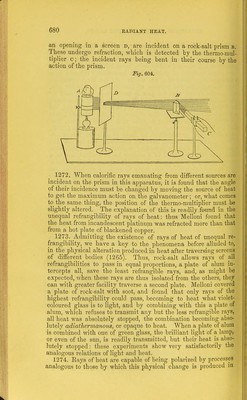
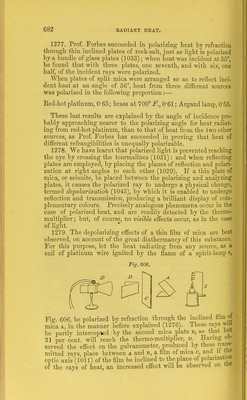
![1277. Prof._ Forbes succeeded in polarizing heat hy refractiou through thin inclined plates of rock-salt, just as light is polarized by a bundle of glass plates (1033); when heat was incident at 35°, he found that with three plates, one seventh, and with six, one half, of the incident rays were polarized. When plates of split naica were arranged so as to reflect inci- dent heat at an angle of 56°, heat from three different sources was polarized in the following proportion:— Red-hot platinum, 0'65; brass at 700°i^., 0-61; Argand lamp, 0-55. These last results are explained by the angle of incidence pro- bably approaching nearer to the polarizing angle for heat radiat- ing from red-hot platinum, than to that of heat from the two other sources, as Prof. Forbes has succeeded in proving that heat of diffei-ent refrangibilities is unequally polarizable. 1278. We have learnt that polarized light is prevented reaching the eye by crossing the tourmalines (1031): and when reflecting plates are employed, by placing the planes of reflection and polari- zation at right angles to each other (1029). If a thin plate of mica, or selenite, be placed between the polarizing and analyzing plates, it causes the polarized ray to undergo a physical change, termed depolarizatioh (1043), by which it is enabled to undergo reflection and transmission, producing a brilliant display of com- plementary colours. Precisely analogous phenomena occur in the case of polarized heat, and are readily detected by the thermo- multiplier; but, of course, no visible effects occur, as in the case of light. 1279. The depolarizing effects of a thin film of mica are best observed, on account of the great diathermancy of this substance. For this purpose, let the heat radiating from any source, as a coil of platinum wire ignited by the flame of a spirit-lamp s, Fig. 606, be polarized by refraction^ through the inclined film mica A, in the manner before explained (127GV These rays w be partly intercepted by the second mica plate b, bo that b 21 per cent, will reach the thermo-multiplier, d. Having o served the effect on the galvanometer, produced by these trar mitted rays, place between a and b, a film of mica c, and it ti optic axis(101]) of the film be inclined to the plane of polanzati; of the rays of heat, an increased effect will be observed on t. Fiff. 606.](https://iiif.wellcomecollection.org/image/b22650271_0718.jp2/full/800%2C/0/default.jpg)