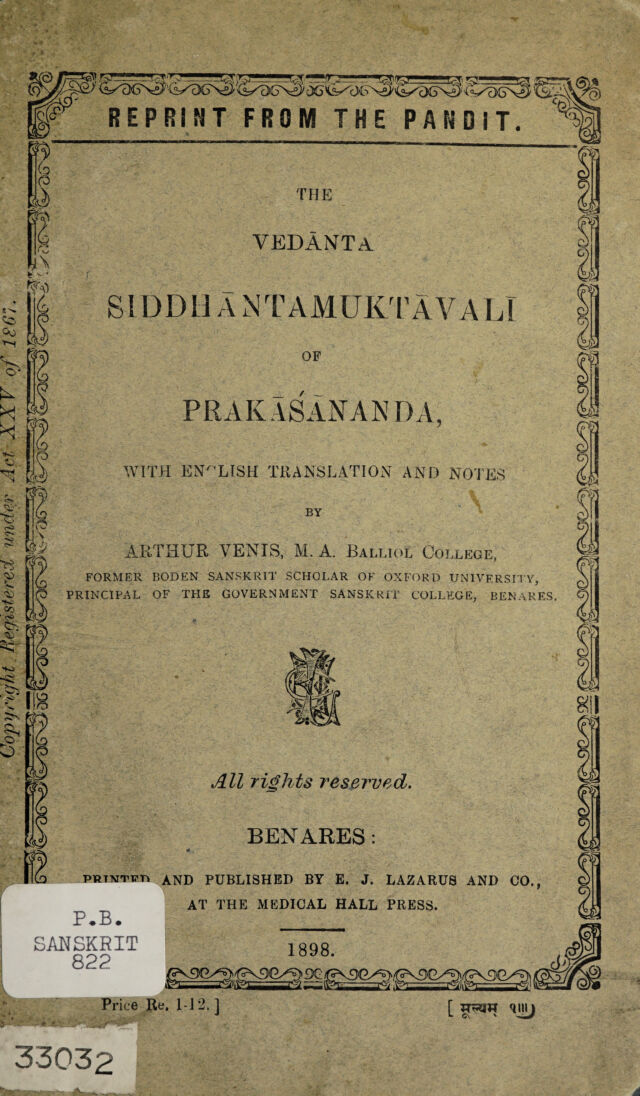
The Vedanta Siddhantamuktāvali / with English translation and notes by Arthur Venis.
- Prakāśānanda, active 16th century
- Date:
- 1898
Licence: Public Domain Mark
Credit: The Vedanta Siddhantamuktāvali / with English translation and notes by Arthur Venis. Source: Wellcome Collection.
30/200
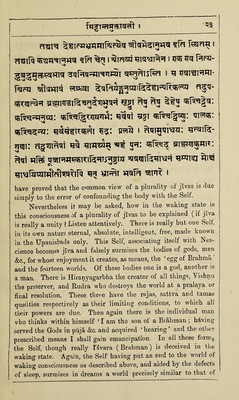
![ftrfTfrWWg??) I ^isfiiiJsi^ii 3i3TiiH?g ^5^13PitJungs: i gg ^irg^m^fq ^T<^^^?T5Rg^ggqg^q sag- Wit: ^Tqij^ifj wfh g tnTOij^ snntti^g fttq wiviin ww g grair5fiRi?g| rj^mg'rjfn i ^'tiw: C\ ^ 0155^1^ ng^rs^ig^T ^m 1 Hr^i grUl^fd ^T n]k^ tt II §f^ ^IKl^lf&SRiqTT^rXl ^^m^rof ^flli^^- is denied; for then there can be only two kinds of existence, viz., the absolutely real (paraniarthiki) and the merely perceptional (pratitiki). If (he continues) the existence of an unperceived object is denied, it should follow that the man, who leaves son and home and herds and all other sources of joy, should die weeping and consamed by sorrow in the conviction that these loved objects exist not, since he no longer beholds them. Here the opponent (speaking in v, 10.) might be asked by way of objection, why experience of a dual order of things whose existence is merely perceptional is not possible in the waking state, as it is possible in the dreaming state, (for all schools hold that the esse of the dream-world is percipi). This objection he would put aside, because the waking and dreaming states are dissimilar: for whereas the latter state is put an end to by wak¬ ing knowledge, there is no sublation of the world in the waking state previous to an intuition of Brahman. To the opponent’s view they rejoin:— The man who maintains three different kinds of existence must be asked whether he holds duality to be real or unreal. Real it cannot be. If unreal (non-exis¬ tent, asatya); how can existence (sattva) be three-fold ?...XL Does the opponent prove that an object exists even when Met : the common sense view that a thing exists even when unpeiceived is beset with difficulties: Ancient teach¬ ers admitted vyavahariki satta only out of a kind regard for the needs of the vulgar mind.](https://iiif.wellcomecollection.org/image/b30095256_0030.jp2/full/800%2C/0/default.jpg)




 No text description is available for this image
 No text description is available for this image
 No text description is available for this image