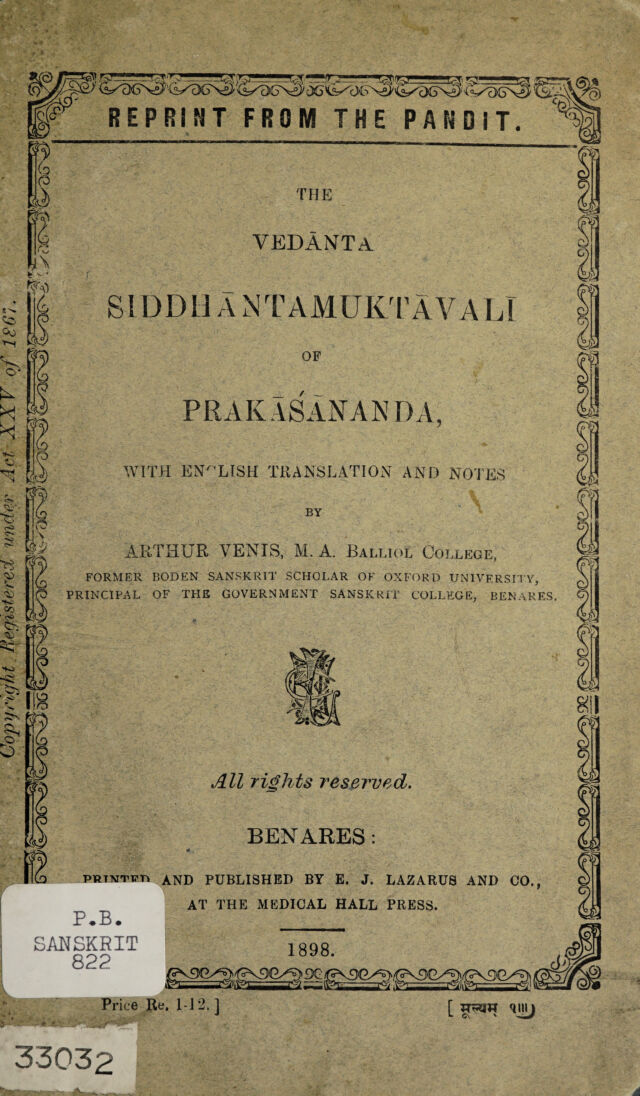
The Vedanta Siddhantamuktāvali / with English translation and notes by Arthur Venis.
- Prakāśānanda, active 16th century
- Date:
- 1898
Licence: Public Domain Mark
Credit: The Vedanta Siddhantamuktāvali / with English translation and notes by Arthur Venis. Source: Wellcome Collection.
7/200
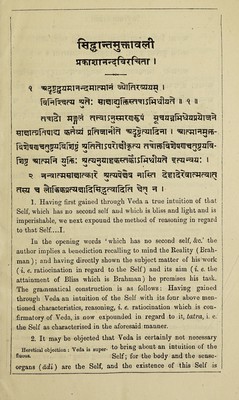
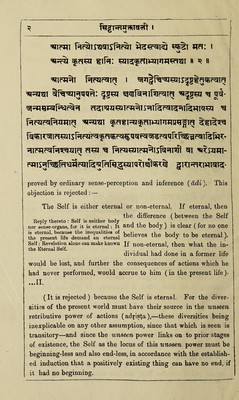
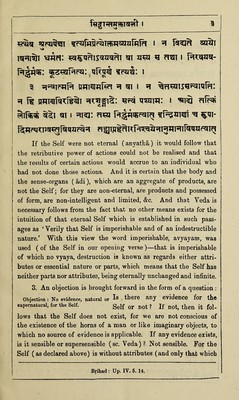
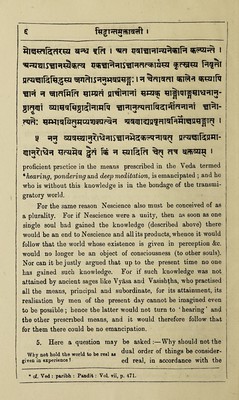
![mi^r^ra >5^: qmi?]Rfi^'^isSi^ra^ « <i « >A >* I Ilf|^ggf«^an^T^^ 53TgTriiI?mra ^iHsd 'sisgr^ira^ii l ^IrUIsiJgfS- I ^ ' I fis^^nn^gguiBii^g ^^h^IS^T^^f r^ riiifiifg^^nii^gga^- i f^s '?«ir3nf% niffi: *?ipa5i5mi5K?Piiismvfiii^ ^rii=9q; i 5; sjsgifngigTr^i^ safuqiig s> ^ ?l?ff ^ ^f«5RnrHgif?I%5rgif5f?1 rl I' 1. Having first gained through Veda a true intuition of that Self, which has no second self and which is bliss and light and is imperishable, we next expound the method of reasoning in regard to that Self....I. In the opening words ‘ which has no second self, &c.’ the author implies a benediction recalling to mind the Reality {Brah¬ man ); and having directly shown the subject matter of his work (i. e. ratiocination in regard to the Self) and its aim {i. e. the attainment of Bliss which is Brahman) he premises his task. The grammatical construction is as follows: Having gained j through Veda an intuition of the Self with its four above men¬ tioned characteristics, reasoning, i. e. ratiocination which is con¬ firmatory of Veda, is now expounded in regard to it, tdtvd, i. e. the Self as characterised in the aforesaid manner. 2. It may be objected that Veda is certainly not necessary Heretical objection : Veda is super- *0 bring about an intuition of the fluous. Self; for the body and the sense- organs (adi) are the Self, and the existence of this Self is -——-— ----](https://iiif.wellcomecollection.org/image/b30095256_0007.jp2/full/800%2C/0/default.jpg)


 No text description is available for this image
 No text description is available for this image
 No text description is available for this image