On the alleged infecundity of females born co-twins with males : with some notes on the average proportion of marriages without issue in general society / by James Y. Simpson.
- James Young Simpson
- Date:
- [©1844?]
Licence: Public Domain Mark
Credit: On the alleged infecundity of females born co-twins with males : with some notes on the average proportion of marriages without issue in general society / by James Y. Simpson. Source: Wellcome Collection.
Provider: This material has been provided by The University of Glasgow Library. The original may be consulted at The University of Glasgow Library.
14/20 (page 12)
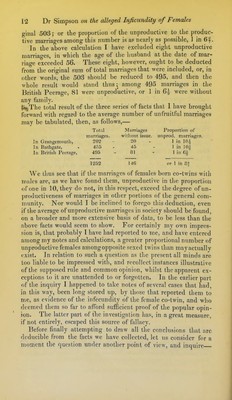
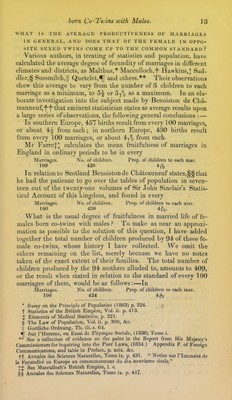
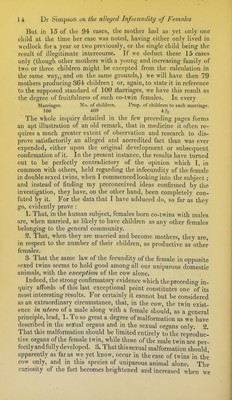
![ginal 503; or the proportion of the unproductive to the produc- tive marriages among this number is a? nearly as possible, ] in 6f. In the above calculation I have excluded eight unproductive marriages, in which the age of the husband at the date of mar- riage exceeded 56. These eight, however, ought to be deducted from the original sum of total marriages that were included, or, in other Avords, the 503 should be reduced to 495, and then the whole result would stand thus; among 495 marriages in the British Peerage, 81 were unproductive, or 1 in 65 were without any family. ^|The total result of the three series of facts that 1 have brought forward with regard to the average number of unfruitful marriages may be tabulated, then, as follows,— Tot:il Marriages Proportion of marriages. witlioin issue, uriprod. marriages. In Grangemouth, 202 - 20 - 1 in 10^ ]n Bathgate, - 4;')5 - 45 - 1 in 10^ J n British Peerage, 495 - 81 - 1 in 1252 Nfi or 1 in VA We thus sec that if the marriages of females born co-twins with males are, as we have found them, unproductive in the proportion of one in 10, they do not, in this respect, exceed the degree of un- ])roductiveness of marriages in other portions of the general com- munity. Nor would I be inclined to forego this deduction, even if the average of unproductive marriages in society should be found, on a broader and more extensive basis of data, to be less than the above facts would seem to show. For certainly my own impres- h^ion is, that probably I have had reported to me, and have entered among my notes and calculations, a greater proportional number of unproductive females amongopposite sexed twins than may actually exist. In relation to such a question as the present all minds arc too liable to be impressed with, and recollect instances illustrative of the supposed rule and common opinion, whilst the apparent ex- ceptions to it are unattended to or forgotten. In the earlier part of the inquiry I happened to take notes of several cases that had, in this way, been long stored up, by those that reported them to me, as evidence of the infecundity of the female co-twin, and who deemed them so far to afford sufficient proof of the popular opin- ion. The latter part of the investigation has, in a great measure, if not entirely, escaped this source of fallacy. Before finally attempting to draw all the conclusions that arc dcducible from the facts we have collected, let us consider for a moment the question under another point of view, and inquire](https://iiif.wellcomecollection.org/image/b21470510_0014.jp2/full/800%2C/0/default.jpg)