Decorative art of the Huichol Indians / by Carl Lumholtz.
- Carl Sofus Lumholtz
- Date:
- 1904
Licence: Public Domain Mark
Credit: Decorative art of the Huichol Indians / by Carl Lumholtz. Source: Wellcome Collection.
25/74 page 289
![II.—CATALOGUE OF CONVENTIONAL DESIGNS. The following pages contain a catalogue of the designs for which I have been able to obtain explanations. I have arranged the material according to the interpretation of the designs, not in accordance with their forms. Beginning with a number of designs interpreted as representations of artificial objects,—the double water-gourd, comb, steel, the stick for painting arrows, the notched deer-bone, the staff of Grandmother Growth, the jew’s-harp,—I have taken up next designs representing mammals, birds, reptiles, and other animals ; then those interpreted as plants; and finally a small group of miscellaneous objects. Many of the specimens contain more than one design. Whenever it seemed necessary, the illustrations of these have been repeated in their appropriate places. In all other cases references to other occurrences of the same design have been added. In the descriptive remarks attention has been called to a few of the striking similarities between designs of different interpretation. Some of the original interpretations given to me by the Indians seem to conflict with other evidence. In all these cases I have been careful to state the original infor¬ mation obtained from the natives. DESIGN No. i.—DOUBLE WATER-GOURD (Huichol, topoli'r or kurau'li). See Figs. 370-386; also 389, 401, 407, 413, 414, 4*9, 422, 43°, 442, 483, 484, 487, 504, 505, 5x3, 517, 520, 526, 528, xxii, 1-4, 7, 10, 11; also p. 113 of this volume and p. 126 (Figs. 134 j and 135 d). Gourds are raised only on a small scale, but nevertheless are much appreciated. There are three kinds—those that are eaten, those from which tobacco-gourds are made, and those from which single or double water-gourds are made. All play a very important part in the life of the Huichol. No dish is more appreciated than the squash, which is called in Huichol ru'tsi, while the dry gourds are in general called kurau'li. Tobacco-gourds (Huichol, ya'kwai) are sacred, and a necessary part of the hikuli-seeker’s outfit.1 The large oval water-gourds (Spanish, bule; Huichol, kdye') are used by the women for carrying water to the house. The lower part is enclosed in a netting of strong twine made of bark fibre. The loop by which the gourd is carried is attached to two opposite sides of the netting, and passes over the forehead, or sometimes around the neck. For stoppers, bunches of leaves from the big-leaved oak-tr or corn-cobs, are used. Other water-gourds are round shape, and are called za'pala (“round”). A hole is made one side. Such gourds are entirely incased in a netting of bark fibre, and then carried in a similar way to the others. The double water-gourd is a natural growth resembling two gourds connected by a slender neck. Symbolic figures, especially of the deer and hikuli, are sometimes Fig. 368. The Double Water-Gourd of the Hikuli-Seeker. Height, 22.5 cm. See Part I of this volume, pp. 190-192, also 17-20. [289]](https://iiif.wellcomecollection.org/image/b31365139_0027.jp2/full/800%2C/0/default.jpg)


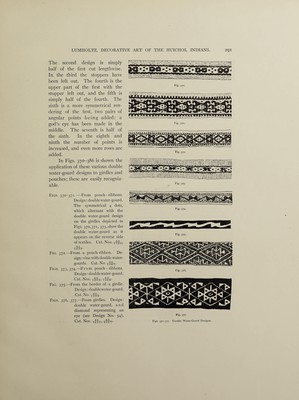

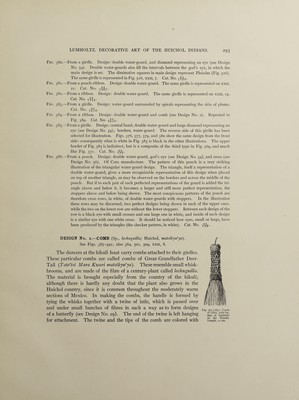
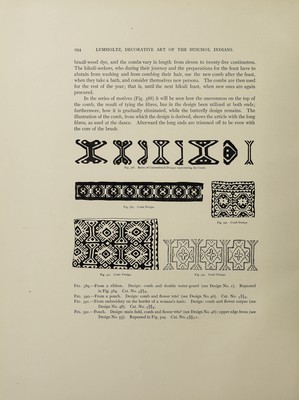
 No text description is available for this image
 No text description is available for this image
 No text description is available for this image