Volume 1
Medical malpractice : report of the Secretary's Commission on Medical Malpractice.
- United States. Department of Health, Education, and Welfare. Secretary's Commission on Medical Malpractice
- Date:
- 1973
Licence: Public Domain Mark
Credit: Medical malpractice : report of the Secretary's Commission on Medical Malpractice. Source: Wellcome Collection.
75/180 (page 45)
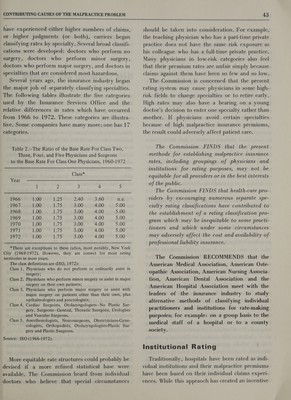
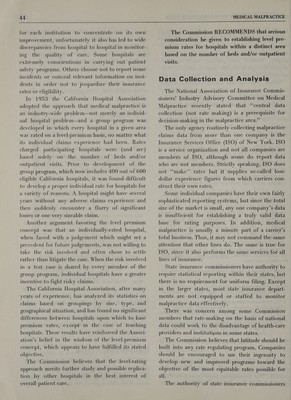
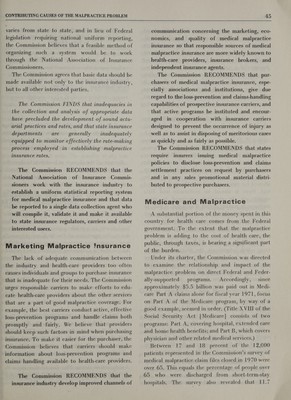
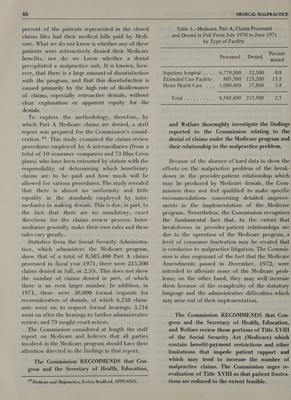
![varies from state to state, and in lieu of Federal legislation requiring national uniform reporting, the Commission believes that a feasible method of organizing such a system would be to work through the National Association of Insurance Commissioners. The Commission agrees that basic data should be made available not only to the insurance industry, but to all other interested parties. The Commission FINDS that inadequacies in the collection and analysis of appropriate data have precluded the development of sound actu- arial practices and rates, and that state insurance departments are generally —_ inadequately equipped to monitor effectively the rate-making process employed in establishing malpractice insurance rates. The Commission RECOMMENDS that the National Association of Insurance Commis- sioners work with the insurance industry to establish a uniform statistical reporting system for medical malpractice insurance and that data be reported to a single data collection agent who will compile it, validate it and make it available to state insurance regulators, carriers and other interested users. Marketing Malpractice 'nsurance The lack of adequate communication between the industry and health-care providers too often causes individuals and groups to purchase insurance that is inadequate for their needs. The Commission urges responsible carriers to make efforts to edu- cate health-care providers about the other services that are a part of good malpractice coverage. For example, the best carriers conduct active, effective loss-prevention programs and handle claims both promptly and fairly. We believe that providers should keep such factors in mind when purchasing insurance. To make it easier for the purchaser, the Commission believes that carriers should make information about loss-prevention programs and claims handling available to health-care providers. The Commission RECOMMENDS that the insurance industry develop improved channels of communication concerning the marketing, eco- nomics, and quality of medical malpractice insurance so that responsible sources of medical malpractice insurance are more widely known to health-care providers, insurance brokers, and independent insurance agents. The Commission RECOMMENDS that pur- chasers of medical malpractice insurance, espe- cially associations and institutions, give due regard to the loss-prevention and claims-handling capabilities of prospective insurance carriers, and that active programs be instituted and encour- aged in cooperation with insurance carriers designed to prevent the occurrence of injury as well as to assist in disposing of meritorious cases as quickly and as fairly as possible. The Commission RECOMMENDS that states require insurers issuing medical malpractice policies to disclose loss-prevention and claims settlement practices on request by purchasers and in any sales promotional material distri- buted to prospective purchasers. Medicare and Malpractice A substantial portion of the money spent in this country for health care comes from the Federal problem is adding to the cost of health care, the public, through taxes, is bearing a significant part of the burden. Under its charter, the Commission was directed to examine the relationship and impact of the malpractice problem on direct Federal and Feder- ally-supported programs. Accordingly, — since approximately $5.5 billion was paid out in Medi- care Part A claims alone for fiscal year 1971, focus on Part A of the Medicare program, by way of a good example, seemed in order. (Title X VII of the Social Security Act [Medicare] consists of two programs: Part A, covering hospital, extended care and home health benefits; and Part B, which covers physician and other related medical services.) Between 17 and 18 percent of the 12,000 patients represented in the Commission’s survey of medical malpractice claim files closed in 1970 were over 65. This equals the percentage of people over 65 who were discharged from short-term-stay hospitals. The survey also revealed that 11.7](https://iiif.wellcomecollection.org/image/b32220339_0001_0075.jp2/full/800%2C/0/default.jpg)