The complete biscuit and gingerbread baker's assistant : practical directions for making all kinds of plain and fancy biscuits ... Adapted for the trade or for private families. The only work exclusively on this subject.
- Read, George
- Date:
- 1855
Licence: Public Domain Mark
Credit: The complete biscuit and gingerbread baker's assistant : practical directions for making all kinds of plain and fancy biscuits ... Adapted for the trade or for private families. The only work exclusively on this subject. Source: Wellcome Collection.
Provider: This material has been provided by The University of Leeds Library. The original may be consulted at The University of Leeds Library.
110/122 (page 98)
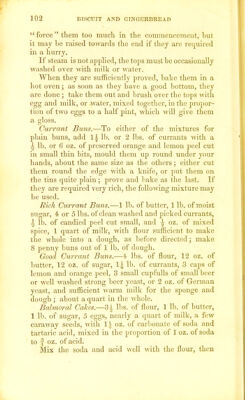
![Care should he taken that the water or milk is not so hot as to scald the yeast, as that would render them quite heavy; the same observation holds good with respect to the flour, for if that is scalded the same effect is produced, although the yeast may not he so; for the gluten of the flour is injured by it, and the starch is converted into a jelly, so that the “ life ” of the flour, as it is termed, no longer exists with it, and the yeast remains almost inactive. The gluten has not the ]lower to expand itself and receive the fixed air re- sulting from the gasefication, the surface of the dough will appear in bladders or bubbles, and it otherwise looks greasy and flabby, having a heavy feel, similar to glaziers’ putty. In “ seasoning ” milk for buns with small beer yeast, when it has not been previously washed, I usually add as much as will impart to it a slight taste of the yeast. The buns, even then, if they should be rather heavy, will at all times sell much better than if they are bitter; therefore, of two evils, if one must be, by this precaution I choose the least. From a quarter to half a pint of good small beer yeast will be required for each quart of milk. Observe.—A quart of milk, when made into a dough for buns with Dutch yeast, will take about 4 or lbs. of flour in the whole ; and for small beer yeast, with the addition of half a pint of it, will take about 5 lbs. of flour: with these rules and remarks, it will be unnecessary to mention anything relating to it again under the various receipts. To Keep German Yeast.—This yeast is so univer- sally used in the metropolis, as well as other places, that a few words will be necessary on this head. 1st. Care should be taken that it is not thrown down, or in anywise bruised by falls, or it will be spoiled in consequence. 2nd. When the yeast is delivered in a dry state, it should be then kept in a cool damp place; if in a damp condition, in a dry cool place.](https://iiif.wellcomecollection.org/image/b21533003_0110.jp2/full/800%2C/0/default.jpg)