The book of days : a miscellany of popular antiquities in connection with the calendar, including anecdote, biography, & history, curiosities of literature and oddities of human life and character / edited by R. Chambers.
- Date:
- 1863
Licence: Public Domain Mark
Credit: The book of days : a miscellany of popular antiquities in connection with the calendar, including anecdote, biography, & history, curiosities of literature and oddities of human life and character / edited by R. Chambers. Source: Wellcome Collection.
49/854 (page 35)
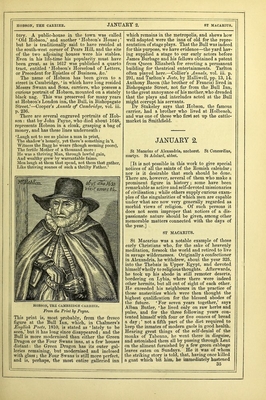
![HOBSON, THE CARRIER. tury. A public-house in the town was called ‘ Old Hobson,’ and another ‘ Hobson’s House; ’ but he is traditionally said to have resided at the south-west corner of Pears Hill, and the site of the two adjoining houses were his stables. Even in his life-time his popularity must have been great, as in 1617 was published a quarto tract, entitled ‘Hobson’s Horseload of Letters, or Precedent for Epistles of Business, &c.’ The name of Hobson has been given to a street in Cambridge, ‘ in which have long resided Messrs Swann and Sons, carriers, who possess a curious portrait of Hobson, mounted on a stately black nag. This was preserved for many years at Hobson’s London inn, the Bull, in Bishopsgate Street.’—Cooper’s Annals of Cambridge, vol. iii. p. 236. There are several engraved portraits of Hob- son : that by John Payne, who died about 1648, represents Hobson in a cloak, grasping a bag of money, and has these lines underneath: ‘ Laugh not to see so plaine a man in print, The shadow’s homely, yet there’s something in’t. Witness the Bagg he wears (though seeming poore), The fertile Mother of a thousand more : He was a thriving Man, through lawful gain, And wealthy grew by warrantable faime. Men laugh at them that spend, not them that gather, Like thriving sonnes of such a thrifty Father. ’ HOBSON, THE CAMBRIDGE CARRIER. From, the Print by Payne. This print is, most probably, from the fresco figure at the Bull Inn, which, in Chalmers’s English Poets, 1810, is stated as ‘ lately to be seen,’ but it has long since disappeared; and the Bull is more modernised than either the Green Dragon or the Four Swans inns, at a few houses distant: the Green Dragon has its outer gal- leries remaining, but modernised and inclosed with glass ; the Four Swans is still more perfect, and is, perhaps, the most entire galleried inn which remains in the metropolis, and shews how well adapted were the inns of old for the repre- sentation of stage plays. That the Bull was indeed for this purpose, we have evidence—the yard hav- ing supplied a stage to our early actors before James Burbage and his fellows obtained a patent from Queen Elizabeth for erecting a permanent building for theatrical entertainments. Tarlton often played here.—Collier’s Annals, vol. iii. p. 291, and Tarlton’s Jests, by Halliwell, pp. 13, 14. Anthony Bacon (the brother of Francis) lived in Bishopsgate Street, not far from the Bull Inn, to the great annoyance of his mother, who dreaded that the plays and interludes acted at the Bull might corrupt his servants. Dr Stukeley says that Hobson, the famous carrier, had a brother who lived at Holbeach, and was one of those who first set up the cattle- market in Smithfield. JANUARY 2. St Macarius of Alexandria, anchoret. St Concordius, martyr. St Adelard, abbot. [It is not possible in this work to give special notices of all the saints of the Romish calendar; nor is it desirable that such should be done. There are, however, several of them who make a prominent figure in history; some have been remarkable as active and self-devoted missionaries of civilisation; while others supply curious exam- ples of the singularities of which men are capable under what are now very generally regarded as morbid views of religion. Of such persons it does not seem improper that notices of a dis- passionate nature should be given, among other memorable matters connected with the days of the year.] ST MACARIUS. St Macarius was a notable example of those early Christians who, for the sake of heavenly meditation, forsook the world and retired to live in savage wildernesses. Originally a confectioner in Alexandria, he withdrew, about the year 325, into the Thebais in Upper Egypt, and devoted himself wholly to religious thoughts. Afterwards, he took up his abode in still remoter deserts, bordering on Lybia, where there were indeed other hermits, but all out of sight of each other. He exceeded his neighbours in the practice of those austerities which were then thought the highest qualification for the blessed abodes of the future. ‘For seven years together,’ says Alban Butler, ‘he lived only on raw herbs and pulse, and for the three following years con- tented himself with four or five ounces of bread a day; ’ not a fifth part of the diet required to keep the inmates of modern gaols in good health. Hearing great things of the self-denial of the monks of Tabenna, he went there in disguise, and astonished them all by passing through Lent on the aliment furnished by a few green cabbage leaves eaten on Sundays. He it was of whom the striking story is told, that, having once killed a gnat which bit him, he immediately hastened](https://iiif.wellcomecollection.org/image/b24885332_0049.jp2/full/800%2C/0/default.jpg)