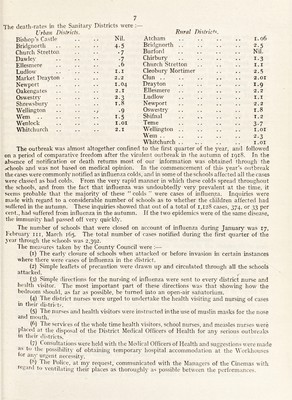
[Report 1919] / Medical Officer of Health, Salop / Shropshire County Council.
- Shropshire (England). County Council.
- Date:
- 1919
Licence: Attribution 4.0 International (CC BY 4.0)
Credit: [Report 1919] / Medical Officer of Health, Salop / Shropshire County Council. Source: Wellcome Collection.
22/58 (page 9)
![Malaria, Dysentery, Trench Fever, Acute Primary Pnenmonia and Acute Influenzal PfV monia arc now notifiable under the Public Health (Pneumonia, Malaria. Dysentery, etc.) Re/'ul.ilions, Under these Re^'ulations the Medical Dfficer of Health has on receipt of a notification, or becoming aware of a case, to take steps to investigate sources of infection, to prevent spread of infection, and, if no p>racfitioner is in attendance, to ascertain the nature of the case. If the rase is outside the district, he has to notify the Medical Officer of Hcalll) concerned. A case of Trench Fever, Typluis Fever, Relapsing Fever, or Malaria, contracted in this countrc’, or an outbreak of Dysentery, lias to be notified to the Ministry of Health and the County Medical Officer of Health. Cases of Malaria, Trench Fever and Dysentery have to be treated, if possible, in suitable ho'.j)itals, unless tlie Medical Officer of Health considers they can be treated with safety at home, Tii anC case of Malaria occurring in a district where the Medical Officer of Health considers that precautions are necessar}', he shall take steps to ensure that the patient (i) is supplied with mosquito netting, (2) receives necessary quinine treatment and proper advice for its continuation, (q) receives advice as to precautions. If two or more cases are contracted in the district the Sanitary Authority may appoint and, if required by the Local Government Board, shall appoint a medical practitioner to supervise the household and take effective measures. In the case of Dysentery, power is given to the Medical Officer of Health to prevent a person ]ne]iaring or handling food, to e.xclude children from school and to take suitable measures “ with respect to cleansing, disinfection, disposal of excreta, destruction of flies, and prevention of contamination of articles of food or drink for human consumption.” Power is also given to the Medical Officer of Health to prevent a *' carrier ” of dysentery or tyjdioid fever being emploj^ed in any trade connected with the preparation or handling of food or drink. In Trench Fever, Tj'phus or Relapsing Fever, power is given to secure the destruction of lit e on the person or clothing of every occupant of a building and of lice or their products in the building. Where there is a suitable hospital, power of removal of a patient suffering from Trench I'evc-r, Malaria, or Dysenter^q is given on the certif cate of the Medical Officer of Health, if he patient is without proper lodging accommodation. Local Authority is empowered to provide medical and nursing assistance for persons suffering from any of the diseases mentioned in the regulations if they need assistance. The regulations came into force on March ist, igig. Malaria.—One hundred and eleven cases were notified in the County, but so far as my infor¬ mation goes all these, with the exception o', two outbreaks, were infected abroad, .\ maji at Bicton who had not been out of the County was notified as suffering from malaria, ami the disease was confirmed by microscopical examination of the blood. He had been Inang in llu- same house with a man who had suffered from malaria in the South African M'ar, and had a])i)arently had yearly relapses since. The malaria mosquito was present in large numbers m the farm buildings. The second outbreak was at Coalport, in August. Dr. Gepp, in his nport says:—‘‘Three cases arose locally in one family at Coalport, in August. They were '■I'tcrs, aged 6, 13, and 14. The cases were notified by a medical man, who found the malaria parasites in the patients’ blood. This outbreak was visited and enquired into by Dr. A. C. Parsons '•f the Ministry of Health, in company with the County Medical Officer and myself. The Aii()])heles Maculipennis (malaria mosquito) was found plentifully in the open near the house, •Old one was found by Dr. Parsons in the house. The larvae of the insect were found breeding in the < anal dead-end near by at CoMport. A possible ‘ carrier ’ of infection was found in a man ''turned home from Salonica, who had had two slight recurrent attacks of malaria in .-\ugust. He lived within 400 yards of the affected premises. The children had definite, moderately 'Acre, attacks, which cleared up rapidly under treatmerit, with no recurrence to the end of the year.” * '](https://iiif.wellcomecollection.org/image/b30086577_0024.jp2/full/800%2C/0/default.jpg)