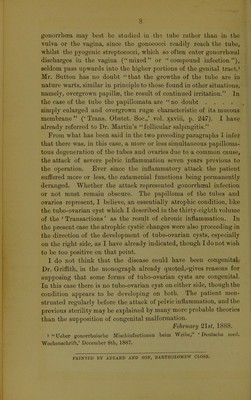
Papilloma of both Fallopian tubes and ovaries / by Alban Doran.
- Doran, Alban H. G. (Alban Henry Griffiths), 1849-1927
- Date:
- 1888
Licence: Public Domain Mark
Credit: Papilloma of both Fallopian tubes and ovaries / by Alban Doran. Source: Wellcome Collection.
Provider: This material has been provided by The Royal College of Surgeons of England. The original may be consulted at The Royal College of Surgeons of England.
1/16
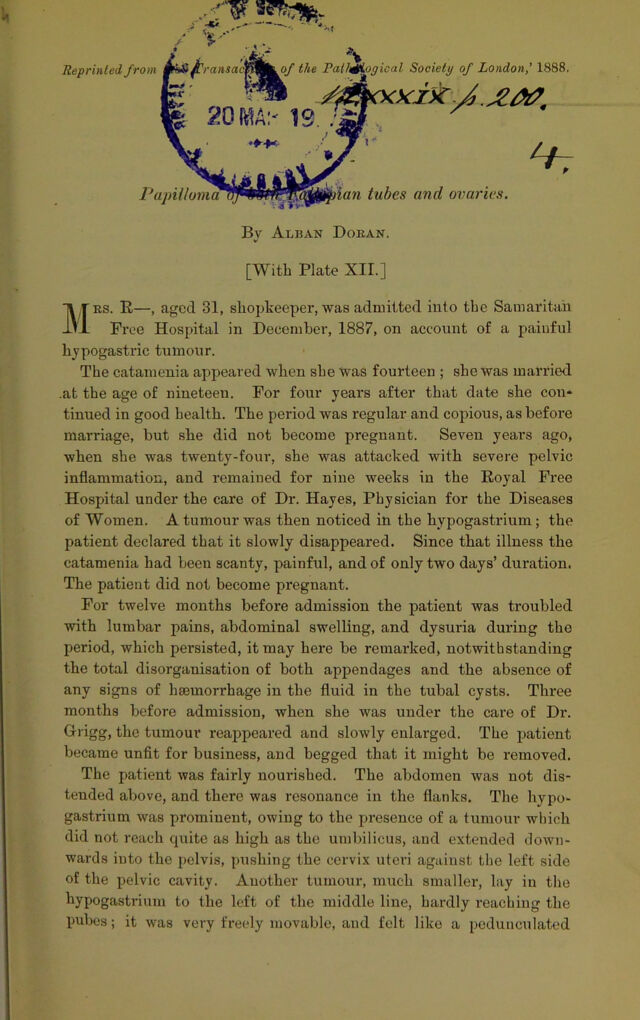
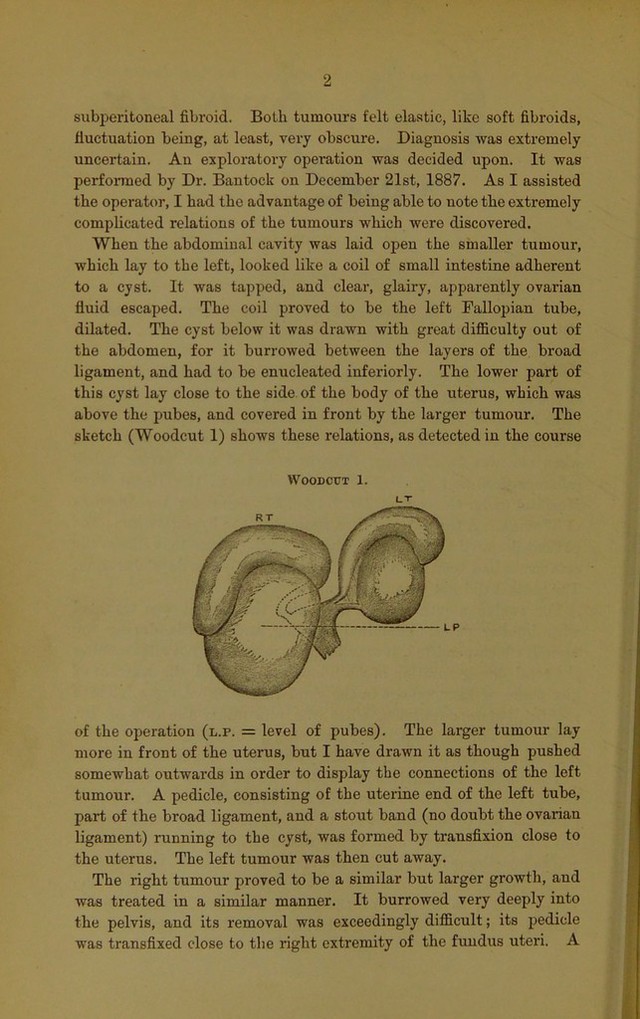
![Reprinted fr By Alban Doran. [With Plate XII.] rs. R—, aged 31, shopkeeper, was admitted into the Samaritan Free Hospital in December, 1887, on account of a painful hypogastric tumour. The catamenia appeared when she was fourteen ; she was married .at the age of nineteen. For four years after that date she con* tinned in good health. The period was regular and copious, as before marriage, but she did not become pregnant. Seven years ago, when she was twenty-four, she was attacked with severe pelvic inflammation, and remained for nine weeks in the Royal Free Hospital under the care of Dr. Hayes, Physician for the Diseases of Women. A tumour was then noticed in the hypogastrium; the patient declared that it slowly disappeared. Since that illness the catamenia had been scanty, painful, and of only two days’ duration. The patient did not become pregnant. For twelve months before admission the patient was troubled with lumbar pains, abdominal swelling, and dysuria during the period, which persisted, it may here be remarked, notwithstanding the total disorganisation of both appendages and the absence of any signs of haemorrhage in the fluid in the tubal cysts. Three months before admission, when she was under the care of Dr. Grigg, the tumour reappeared and slowly enlarged. The patient became unfit for business, and begged that it might be removed. The patient was fairly nourished. The abdomen was not dis- tended above, and there was resonance in the flanks. The hypo- gastrium was prominent, owing to the presence of a tumour which did not reach quite as high as the umbilicus, and extended down- wards into the pelvis, pushing the cervix uteri against the left side of the pelvic cavity. Another tumour, much smaller, lay in the hypogastrium to the left of the middle line, hardly reaching the pubes; it was very freely movable, and felt like a pedunculated](https://iiif.wellcomecollection.org/image/b22456636_0003.jp2/full/800%2C/0/default.jpg)