On the effect of the internal friction of fluids on the motion of pendulums / by G.G. Stokes.
- Sir George Stokes, 1st Baronet
- Date:
- 1851
Licence: Public Domain Mark
Credit: On the effect of the internal friction of fluids on the motion of pendulums / by G.G. Stokes. Source: Wellcome Collection.
Provider: This material has been provided by The Royal College of Surgeons of England. The original may be consulted at The Royal College of Surgeons of England.
97/104 page 93
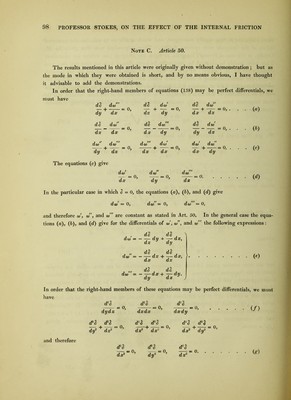
![which in fact is the same as the second of the equations (8). The solution thus obtained is as we have seen t), (181) f denoting a function the form of which there is no need to write down, which satisfies (180) when written for v. Now it will be seen at once that the expression (181) satisfies the exact equation (179), and therefore the approximate solution obtained by the method of Art. 8 is in fact exact, except so far as regards the termination of the disk at its edge, which is what it was required to prove. Passing from semi-polar to polar co-ordinates, by putting % = r cos 6, w = r sin 9, we get from (179)> after writing m'p for dr^ ^ r dr r® sin d ^ do] r^sin*9 y! dt Suppose now the solid to be a sphere, having its centre at the origin. Let a be its radius, 8 its angular velocity, and suppose the fluid initially at rest. Then v is to be deter- mined from the general equation (182) and the equations of condition V = 0 when t = 0, v' = as sin 9 when r = a, v' = 0 when r = oo . All these equations are satisfied by supposing t * r\ V = v sm 0, x> being a function of r and t only. We get from (182) 2 dv 9,v 1 dv dr^ ^ r dr r^ (/ dt (183) If we suppose 8 constant, v will tend indefinitely to become constant as t increases inde- dv finitely, and in the limit = 0, whence we get from (183) and the equations of condition a z v= aS when r = a, v= 0 when r = <» , // V V = — sin 9. r^ This is the solution alluded to in Art. 8 of my paper On the Theories of the Internal Friction of Fluids in motion, Note B, Article 65. Let us resume the problem of Art. 7, but instead of the motion of the plane being periodic, let us suppose that the plane and fluid are initially at rest, and that the plane is then moved with a constant velocity F, and let the notation be the same as in Art. 7.](https://iiif.wellcomecollection.org/image/b22464074_0099.jp2/full/800%2C/0/default.jpg)


 No text description is available for this image
 No text description is available for this image
 No text description is available for this image