Atlas and text-book of dentistry including diseases of the mouth / by Gustav Preiswerk. Edited by George W. Warren.
- Preiswerk, Gustav
- Date:
- 1906
Licence: Public Domain Mark
Credit: Atlas and text-book of dentistry including diseases of the mouth / by Gustav Preiswerk. Edited by George W. Warren. Source: Wellcome Collection.
Provider: This material has been provided by the University of Toronto, Harry A Abbott Dentistry Library, through the Medical Heritage Library. The original may be consulted at the Harry A Abbott Dentistry Library, University of Toronto.
23/482 page 19
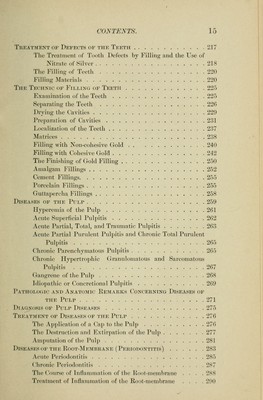
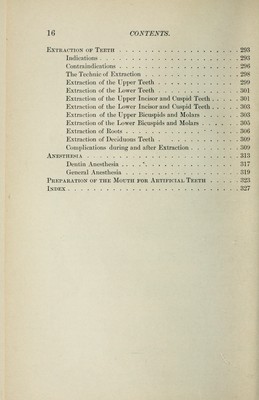
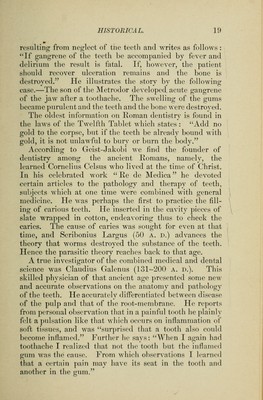
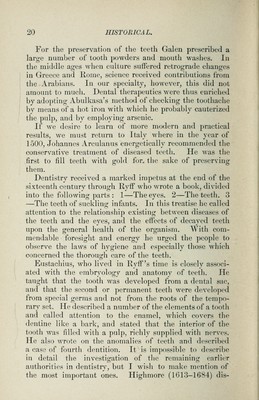
![resulting from nogloct of tiio teeth and writes as follows: If gangrene of the teeth be aeeom])anie(i by fever and delirium the result is fatal. If, however, the patient should rceover ulceration remains and the bone is destroyed. He illustrates the story by the following case.—The son of the ISIetrodor developed, acute gangrene of the jaw after a toothache. The swelling of the gums became purulent and the teeth and the bone were destroyed. The oldest information on Roman dentistry is found in the laws of the Twelfth Tablet which states : Add no gold to the corpse, but if the teeth be already bound with gold, it is not unlawful to bury or burn the body. According to Geist-Jakobi we find the founder of dentistry among the ancient Romans, namely, the learned Cornelius Celsus who lived at the time of Christ. In his celebrated work Re de Medica he devoted certain articles to the pathology and therapy of teeth, subjects which at one time were combined with general medicine. He Mas perhaps the first to practice the fill- ing of carious teeth. He inserted in the cavity pieces of slate wrapped in cotton, endeavoring thus to check the caries. The cause of caries was sought for even at that time, and Seribonius Largus (50 A. T>.) advances the theory that worms destroyed the substance of the teeth. Hence the parasitic theory reaches back to that age. A true investigator of the combined medical and dental science was Claudius Galenus (131-200 A. d.). This skilled physician of that ancient age jiresented some new and accurate observations on the anatomy and pathology of the teeth. He accurately dilfcrentiated between disease of the pulp and that of the root-membrane. He reports from personal observation that in a painful tooth he plainly felt a ])idsati()n like that which occurs on inflammation of soft tissues, and was surpris(Ml Ihat a tooth also could become iuMamed. I'urther he says: When I again had toothache I realized that not the tooth but the inflamed gum was the cause. From which observations I learned that a certain pain may have its seat in the tooth and another in the gum.](https://iiif.wellcomecollection.org/image/b21202849_0023.jp2/full/800%2C/0/default.jpg)
 No text description is available for this image
 No text description is available for this image
 No text description is available for this image