Atlas and text-book of dentistry including diseases of the mouth / by Gustav Preiswerk. Edited by George W. Warren.
- Preiswerk, Gustav
- Date:
- 1906
Licence: Public Domain Mark
Credit: Atlas and text-book of dentistry including diseases of the mouth / by Gustav Preiswerk. Edited by George W. Warren. Source: Wellcome Collection.
Provider: This material has been provided by the University of Toronto, Harry A Abbott Dentistry Library, through the Medical Heritage Library. The original may be consulted at the Harry A Abbott Dentistry Library, University of Toronto.
34/482 page 30
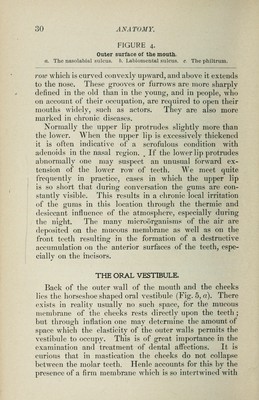
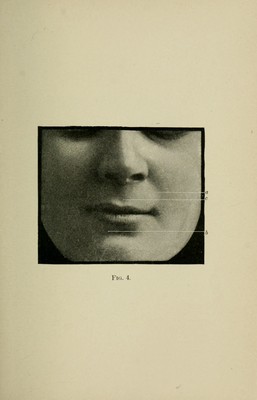
![FIGURE 4. Outer surface of the mouth. a. The nasolabial sulcus, b. Labiomental sulcus, c. The philtrum. roio which is curved convexly upward, and above it extends to the nose. These grooves or furrows are more sharply defined in the old than in the young, and in people, who on account of their occu})ation, are required to open their mouths widely, such as actors. They are also more marked in chronic diseases. Normally the upper lip protrudes slightly more than the lower. When the upper lip is excessively thickened it is often indicative of a scrofulous condition with adenoids in the nasal region. . If the lower lip protrudes abnormally one may suspect an unusual forward ex- tension of the lower row of teeth. AVe meet quite frequently in practice, cases in which the upper lip is so short that during conversation the gums are con- stantly visible. This results in a chronic local irritation of the gums in this location through the thermic and desiccant influence of the atmosphere, es])ecially during the night. The many microorganisms of the air are deposited on the mucous membrane as well as on the front teeth resulting in the formation of a destructive accumulation on the anterior surfaces of the teeth, espe- cially on the incisors. THE ORAL VESTIBULE. Back of the outer wall of the mouth and the cheeks lies the horseshoe shaped oral vestibule (Fig. 5,«). There exists in reality usually no such space, for the mucous membrane of the cheeks rests directly upon the teeth ; but through inflation one may determine the amount of space which the elasticity of the outer walls permits the vestibule to occupy. This is of great importance in the examination and treatment of dental affections. It is curious that in mastication the cheeks do not collapse between the molar teeth. Henle accounts for this by the presence of a firm membrane which is so intertwined with](https://iiif.wellcomecollection.org/image/b21202849_0034.jp2/full/800%2C/0/default.jpg)
 No text description is available for this image
 No text description is available for this image
 No text description is available for this image