A history of English sexual morals / by Ivan Bloch ; translated by William H. Forstern.
- Iwan Bloch
- Date:
- 1936
Licence: In copyright
Credit: A history of English sexual morals / by Ivan Bloch ; translated by William H. Forstern. Source: Wellcome Collection.
38/700 (page 8)
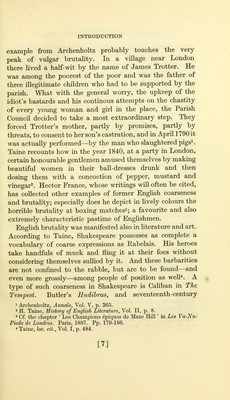
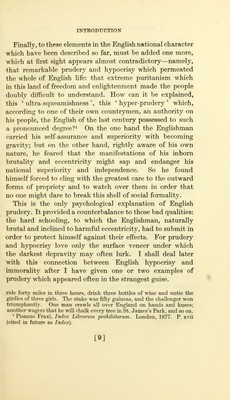
![novels (Swift, Smollett, Fielding and others) form really a monument for ever to the brutality of the age. Hogarth has pictured it in his work1. ' Punch too, their puppet- hero, is a true type of their brutality2. Akin to brutality comes another degenerate growth of the English feeling of independence: the tendency to eccentricity, 4 spleen ' as it was called ; heightened self- consciousness which ventures upon odd enterprises, peculiar and eccentric things, in order to prove before the whole world its originality and independence. Thus every expression of English spleen was mixed with a good dash of arrogance which makes these eccentricities appear even more distasteful. This is not the place to give many instances of spleen3. It was exemplified in the seventeenth century by the Club of Beef-eating Britons4, whose members met weekly to indulge their gluttony; or by the convalescents and invalids of Chelsea and Greenwich, who organised races of—lice, putting them on a table and laying wagers on their turn of speed. The passion for betting was one of the most characteristic expressions of English spleen. It occurred on every possible occasion and often led to the most incredible eccentricity and aberration5. 1 Cf. Taine's brilliant description, Vol. II, p. 448. 2 It will be noted that in stating his case Ivan Bloch chooses fortuitous and somewhat exceptional examples over a period of nearly two hundred years, omitting to make any comparison with similar conditions in other countries during these centuries, or to make any allowance for changing humanitarian standards.—Ed. 3 Philarete Chasles treats the subject of English spleen exhaustively in the second volume of his work Le dixhuitieme Steele en Angleterre. Paris, 1846. 4 Archenholtz, Annals, Vol. V, p. 383. 5 A large collection of examples, illustrating the English passion for betting, is to be found in Traits of English Originals (Leipzig, 1796), a book compiled chiefly from Archenholtz. There one finds, for instance, on p. 64, one of the maddest wagers made in 1773. The bet was to [8]](https://iiif.wellcomecollection.org/image/B20442464_0038.jp2/full/800%2C/0/default.jpg)