Notes on the foundation and history of Marischal College / [W. Martin ].
- Willy Martin
- Date:
- [1849?]
Licence: Public Domain Mark
Credit: Notes on the foundation and history of Marischal College / [W. Martin ]. Source: Wellcome Collection.
58/170 (page 54)
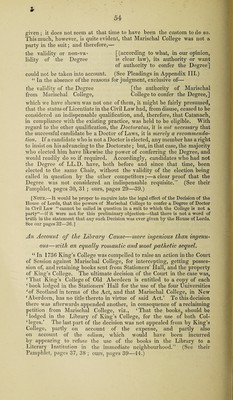
![Sr given ; it does not seem at that time to have been the custom to do so. This much, however, is quite evident, that Marischal College was not a party in the suit; and therefore,— the validity or non-va- [(according to what, in our opinion, lidity of the Degree is clear law), its authority or want of authority to confer the Degree] could not be taken into account. (See Pleadings in Appendix III.) “ In the absence of the reasons for judgment, exclusive of— the validity of the Degree [the authority of Marischal from Marischal College, College to confer the Degree,] which we have shewn was not one of them, it might be fairly presumed, that the status of Licentiate in the Civil Law had, from disuse, ceased to be considered an indispensable qualification, and, therefore, that Catanach, in compliance with the existing practice, was held to be eligible. With regard to the other qualification, the Doctoratus, it is not necessary that the successful candidate be a Doctor of Laws, it is merely a recommenda¬ tion. If a candidate who is not a Doctor is elected, any member has a right to insist on his advancing to the Doctorate; but, in that case, the majority who elected him have likewise the power of conferring the Degree, and would readily do so if required. Accordingly, candidates who had not the Degree of LL.D. have, both before and since that time, been elected to the same Chair, without the validity of the election being called in question by the other competitors;—a clear proof that the Degree was not considered an indispensable requisite.” (See their Pamphlet, pages 30, 31 ; ours, pages 29—39.) [Note.—It would be proper to enquire into the legal effect of the Decision of the House of Lords, that the powers of Marischal College to confer a Degree of Doctor in Civil Law “ cannot be called in question in a suit to which the College is not a party”—if it were not for this preliminary objection—that there is not a word of truth in the statement that any such Decision was ever given by the House of Lords. See our pages 32—36.] An Account of the Library Cause—more ingenious than ingenu¬ ous—with an equally romantic and most pathetic sequel. “ In 1736 King’s College was compelled to raise an action in the Court of Session against Marischal College, for intercepting, getting posses¬ sion of, and retaining books sent from Stationers’ Hall, and the property of King’s College. The ultimate decision of the Court in the case was, ‘ That King’s College of Old Aberdeen is entitled to a copy of each ‘ book lodged in the Stationers’ Hall for the use of the four Universities ‘of Scotland in terms of the Act, and that Marischal College, in New ‘Aberdeen, has no title thereto in virtue of said Act.’ To this decision there was afterwards appended another, inconsequence of a reclaiming petition from Marischal College, viz., ‘That the books, should be ‘ lodged in the Library of King’s College, for the use of both Col¬ leges.’ The last part of the decision was not appealed from by King’s College, partly on account of the expense, and partly also on account of the odium, which would have been incurred by appearing to refuse the use of the books in the Library to a Literary Institution in the immediate neighbourhood.” (See their Pamphlet, pages 37, 38 ; ours, pages 39—44.)](https://iiif.wellcomecollection.org/image/b30560287_0058.jp2/full/800%2C/0/default.jpg)