Special catalogue of the Chinese collection of exhibits for the International Fisheries Exhibition, London, 1883.
- Chinese Maritime Customs Service
- Date:
- [1883]
Licence: Public Domain Mark
Credit: Special catalogue of the Chinese collection of exhibits for the International Fisheries Exhibition, London, 1883. Source: Wellcome Collection.
Provider: This material has been provided by The Royal College of Surgeons of England. The original may be consulted at The Royal College of Surgeons of England.
56/106 (page 46)
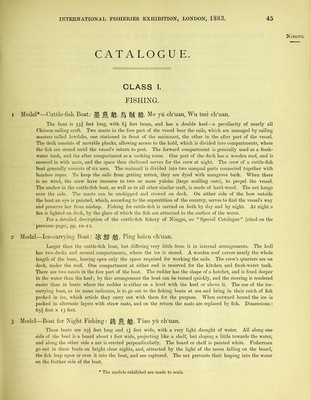
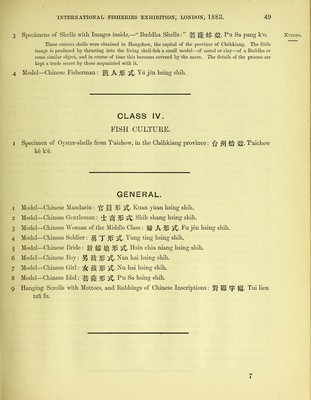
![Ningpo. 4 Model—Small boat 'with. Passenger: >J* ^ Hsiao san pan ta k'e. This represents the familiar “ sampan,”—of a type which is met with more commonly at Shanghai thaa at Ningpo. It is universally employed at Shanghai for conveying passengers—one or two at a time—about the harbour, or between ship and shore. The ingenious manner in which the scull is pivoted on a round- headed iron pin at the stern is worthy of notice. This kind of craft is managed by only one boatman. 5 Model—Bamboo Raft for shallow Water: Chu p‘ai. Craft like these render the very shallowest streams available for the transport of merchandise. 6 Model—Cormorant Boat, full size, with Cormorants and Fisherman: £j| |g fffi, Lu tzu ch'uan. Fishing with cormorants is carried on in lakes, rivers, and canals,—where there is no tide. The boats are very light, 18 feet long by feet wide, and draw but little water. The birds sit on the rail, and are urged into the water by the boatman, with a pole. Baskets carried in the boat receive the fish. Cormorants usually require to have a hempen cord round the neck to prevent their swallowing the fish. The “Special Catalogue” referred to on p. 44 contains an account of the rearing and training of cormorants, and of the manner in which they are employed in fishing ; this account is here reproduced :— “Many are the ways used in this province [Chehkiang] for catching fish of all kinds in the rivers, lakes, and canals, but none of them are more curious than the cormorant fishing, which may be seen everywhere about Ningpo. Certain places are noted for the excellence of the birds which are bred and trained there ; amongst these we may name Fenghua and Shaohsing. “The most celebrated place, however, is a small town called T'anghsichen, 50 li north-west of Hangchow, the people of which are currently believed to possess a secret in cormorant-rearing which gives them special success. “ The cormorant’s book name is Lu tzii, and the common name is Yii ying, 1 fish hawk,’ or Yu ya, ‘ fish crow.’ “ The females lay yearly from three to nine eggs, in the first and eighth moon. The colour of the eggs is green, but it is much covered with white chalk; their size is that of duck’s eggs. The white inside is slightly green, and the eggs are never eaten, on account of their strong flavour. “The eggs of the first season (first moon) are the only ones retained for hatching. Towards the beginning of the second moon they are given to the hens to hatch, as the female cormorant is a careless mother. The young break their shell after a month’s incubation. When new bom they cannot stand on their legs, and are very sensitive to cold. They are therefore taken away from the hen, placed in baskets filled with cotton wool, and kept in a warm place. The eggs of the second season are not used, the weather being too cold ; they are given away to children and beggars. “ The young birds are at first fed with a mixture, in equal parts, of beancurd and raw eel’s flesh cut fine. If eels are not procurable, the flesh of the Hei yii (Ophicephalus niger) is used instead, in the form of small pills. At the end of a month the down begins to be covered by the larger feathers, and the quantity of fish-flesh fed to them is increased, while that of beancurd is reduced. A second month elapses, and the young birds, having grown to double their original size, are fit for the market; a male fetches |i or $2, and a female half as much. “ The birds are now fed with young fish thrown to them. When they have attained their full size, a string is tied to one leg, the other end of it being fastened to the bank of a pond or canal. They are then made to go into the water, the trainer whistling a peculiar call and using a bamboo to force them. Small fish are thrown them, upon which they pounce greedily, as they have been kept on short allowance of food. They are now called back by a different whistle-call, and forced to obey by means of the string; as they reach the shore, more fish is given them. This teaching having been gone through daily for a month, another four or five weeks are spent in training the birds from a boat; at the end of this period the string is generally dispensed with. When old and well trained cormorants are made to accompany the young ones, the time required in training is reduced one half. Birds not properly trained after all the trouble thus taken are pronounced stupid and not fit for use.](https://iiif.wellcomecollection.org/image/b22289379_0058.jp2/full/800%2C/0/default.jpg)