The hand : its mechanism and vital endowments, as evincing design / by Charles Bell.
- Charles Bell
- Date:
- 1860
Licence: Public Domain Mark
Credit: The hand : its mechanism and vital endowments, as evincing design / by Charles Bell. Source: Wellcome Collection.
Provider: This material has been provided by the Francis A. Countway Library of Medicine, through the Medical Heritage Library. The original may be consulted at the Francis A. Countway Library of Medicine, Harvard Medical School.
241/336 (page 201)
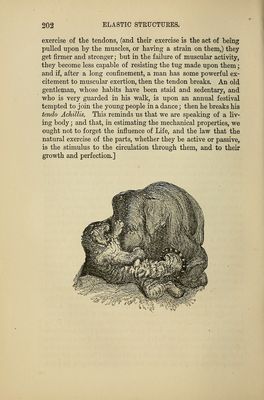
![office of the reservoir containing air, is performed in the animal body by the elasticity of the coats of the arteries; by which means the blood flows uninterruptedly into the arteries, and has a continuous flow in the veins beyond them. But as life advances, the arterial system loses much of its elasticity, and becomes rigid. This is so common an occurrence that we can no more call it a disease than the stiffened joints of an old man; it is the forerunner or the accompaniment of the decline of life. Sometimes this change takes place too early in life, and to an extreme degree; and from its effects we must call it morbid; for it not unfrequently happens that the muscular power of the heart being still entire and vigorous, the arteries can no longer withstand it. They have lost that power which, yielding to the heart's action, resists, recoils, and the more it gives way, the more it takes off the suddenness of the shock; which, in yielding, wastes no power, since the recoil gives as much force to the acceleration of the blood, as was lost of the heart's action. The artery, then, being rigid, yields indeed to the heart's impulse, but has no rebound. It becomes perma- nently dilated or enlarged; and is called aneurismal. A stronger beat of the heart, excited by inordinate action or passion, chips and bursts the now rigid coats of the artery. If the breach be gradual, a pouch forms—a true aneurism. And here is the proof we require; for this bag coming to pulsate upon the solid bones, they are absorbed. That action of the heart, which was so lightly and so easily borne whilst the vessels were elastic, now beating upon a solid structure, in a short time destroys it. Thus, from what takes place on a very slight derangement of the pro- perties of the parts, we are led to a more accurate knowledge of the fine adjustment of the active and resisting properties in the circulating vessels, during youth and health. A piece of rope, of a new patent, has been shown to us, which is said to be many times stronger than any other rope of a like diameter. It is so far formed upon the same principle as the tendon of a muscle, that the strands are plaited, instead of being twisted: but the tendon has still a superiority; for the lesser yarns of each strand in it, are interwoven with those of other strands. It may be asked, however, do not the tendons of the human body sometimes break] They do; and in circum- stances which only add to the interest of the subject. By the](https://iiif.wellcomecollection.org/image/b21041039_0241.jp2/full/800%2C/0/default.jpg)