Volume 1
The science and practice of medicine / By William Aitken ... From the 4th London ed., with additions, by Meredith Clymer.
- William Aitken
- Date:
- 1866
Licence: Public Domain Mark
Credit: The science and practice of medicine / By William Aitken ... From the 4th London ed., with additions, by Meredith Clymer. Source: Wellcome Collection.
Provider: This material has been provided by the University of Massachusetts Medical School, Lamar Soutter Library, through the Medical Heritage Library. The original may be consulted at the Lamar Soutter Library at the University of Massachusetts Medical School.
93/972 page 83
![The Urine in Fever.—The general characters of this excretion proper to the febrile state are deficiency of water, increase of solids, if they are not retained, and especialy of the urea, the uric, the sulphuric, the phosphoric, and the hippuric acids. The pigments also are in- creased; and the chloride of sodium is diminished. The deep color of febrile urine has usually been attributed to its concentration; but if febrile urine he diluted to the usual amount of fluid contained in healthy urine, it is still darker than normal urine. The coloring matter has been shown by Vogel to be increased sometimes four- fold, and it appears to contain more carbon than usual. This color- ing matter in febrile urine is peculiar, and does not give any of the reactions of the bile-pigment. It may, according to Dr. Parkes, be considered as a measure of the metamorphosis of the blood- globules, which in some cases may thus he four times as rapid as in health. Am ulier important fact connected with the chemistry of the urine in fever is th augmentation of its free acidity, as measured by its neu- tralization with soda. The Blood in Fever.—The most trustworthy and interesting facts connected with the chemistry of the blood in fever are,—(1.) A diminution of the alkaline salts, as shown byBecquerel and Rodier in inflammation; (2.) A diminution of alkalinity of the serum, as shown by Cohen; (3.) The diminution of the albumen after the fever has lasted for some time with a commensurate increase in the water of the serum; (4.) A diminution in the numbers of the red corpuscles of the blood; (5.) In certain specific fevers the presence of uric acid has been detected; for instance, in rheumatism, by Dr. Garrod. Of the Pulmonary Excretion, in the febrile state, little is known. Some have found the carbonic acid augmented, others have found it diminished. Dr. Wilks, of Guy's Hospital, found that the ratio of respirations to the pulse is always increased, and that the pulse may be descending while the respiration remains high; such phe- nomena he considers indicative of a positive increase of function ot the lungs. It is important to determine when the blood becomes affected in fever. It has been, and still is, a favorite opinion to refer the origin of fever to primary disease of the blood; and in almost all specific diseases, such as in the miasmatici,. a fever-making cause appears to enter the blood; at least, writes Dr. Parkes, it may be proved to enter in several cases; and a strong analogical argument can be ]'toved of its entrance into others. The fever-making cause also reproduces itself in the blood, or in some organs; and it is now generally admitted that the first action of the febrile cause is on the blood.](https://iiif.wellcomecollection.org/image/b21196606_sciencepracticeo00aitk_0093.jp2/full/800%2C/0/default.jpg)
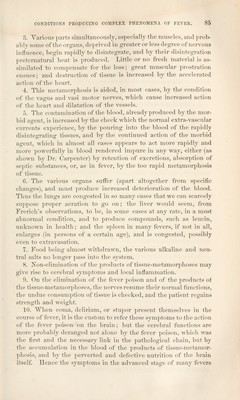
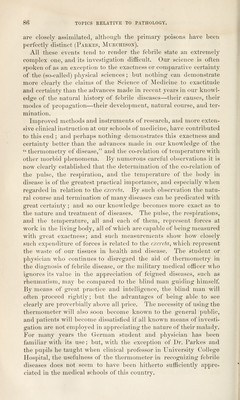
 No text description is available for this image
 No text description is available for this image
 No text description is available for this image