An introduction to the study of embryology / by Alfred C. Haddon.
- Alfred Cort Haddon
- Date:
- 1887
Licence: Public Domain Mark
Credit: An introduction to the study of embryology / by Alfred C. Haddon. Source: Wellcome Collection.
Provider: This material has been provided by University of Bristol Library. The original may be consulted at University of Bristol Library.
140/374 page 106
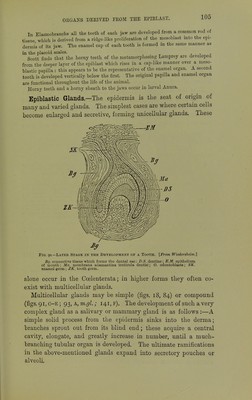
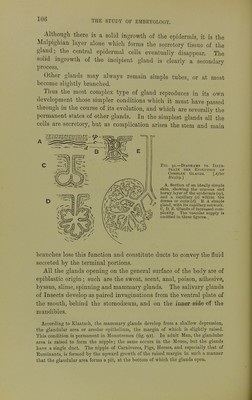
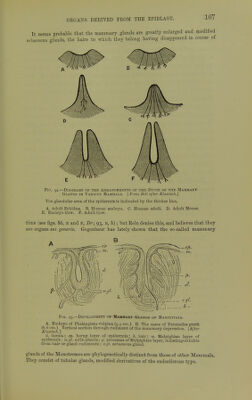
![Althoiigh there is a solid ingrowth of the epidermis, it is the Malpigliian layer alone which forms the secretory tissue of the gland; the central epidermal cells eventually disappear. The solid ingrowth of the incipient gland is clearly a secondary process. Other glands may always remain simple tubes, or at most become slightly branched. Thus the most complex type of gland reproduces in its own development those simpler conditions which it must have passed through in the course of its evolution, and which are severally the permanent states of other glands. In the simplest glands all the cells are secretory, but as complication arises the stem and main FlO. 91.—DlAORAMS TO IlLTJS- TRATE THE EVOLUTION OF Complex Glands. \_AfUr Huxley.] A. Section of an ideally simple skin, showing the mucous and homy layer of the epidermis (ep), and a capillary (c) within the derma or cutis (d). B. A simple gland, with its capillary network. C, D, E. Glands of increased com- plexity. The vascular supply is omitted in these figures., branches lose this function and constitute ducts to convey the fluid secreted by the terminal portions. All the glands opening on the general surface of the body are of epiblastic origin; such are the sweat, scent, anal, poison, adhesive, byssus, slime, spinning and mammary glands. The salivary glands of Insects develop as paired invaginations from the ventral plate of the mouth, behind the stomodseum, and on the inner Bide of the mandibles. According to Klaatsch, the mammary glands develop from a shallow depression, the glandular area or areolar epithelium, the margin of wliich is slightly raised. This condition is permanent in Monotremes (fig. 92). In adult Man, the glandular area is raised to form the nipple; the same occurs in the Mouse, but the glands have a single duct. The nipple of Carnivores, Pigs, Horses, and especially that of Ruminants, is formed by the upward growth of the raised margin in such a manner that the glandular area forms a pit, at the bottom of wliich the glands open.](https://iiif.wellcomecollection.org/image/b21443919_0140.jp2/full/800%2C/0/default.jpg)
 No text description is available for this image
 No text description is available for this image
 No text description is available for this image